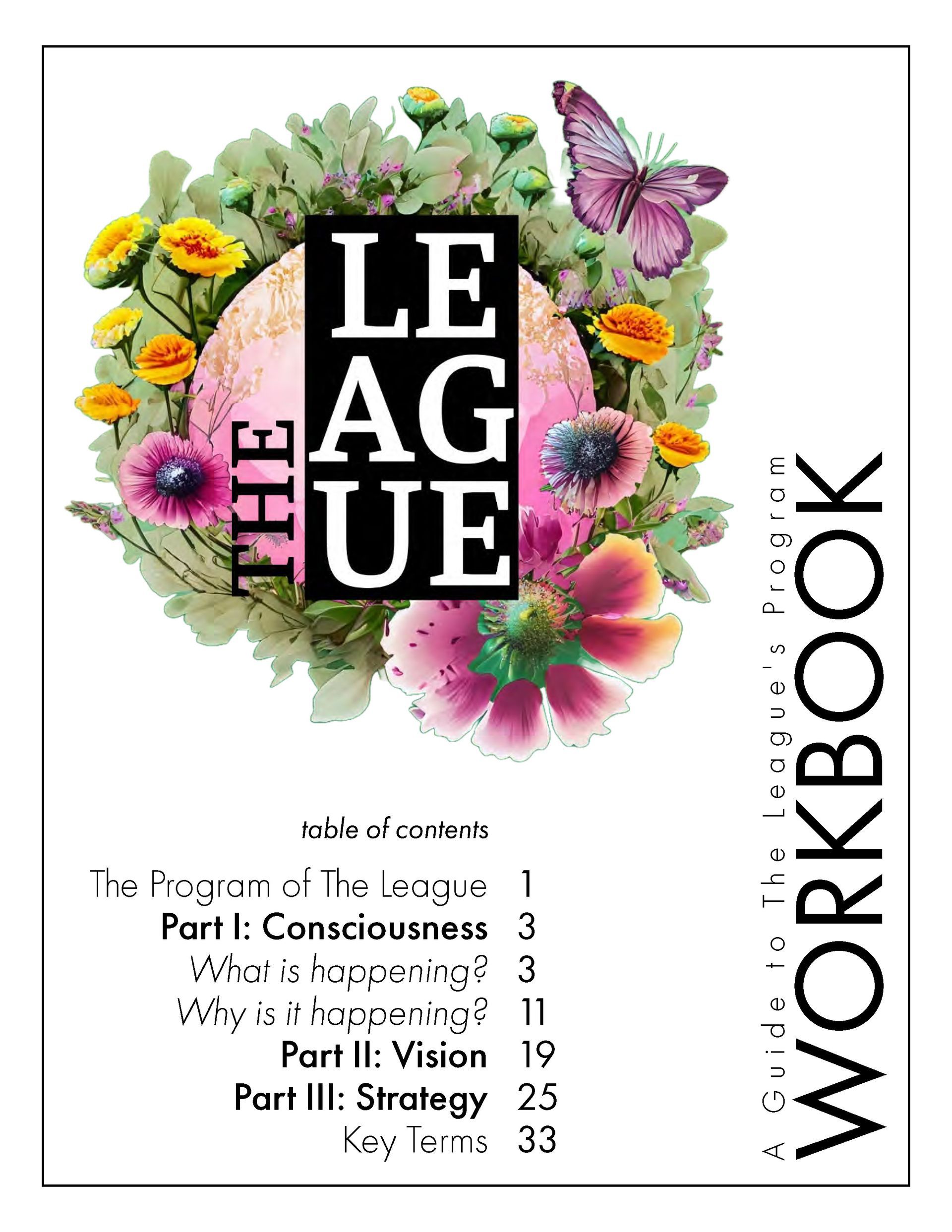
The League Program Workbook
Includes Workbook purpose, organization, facilitator tips, best practices + 3 case studies on using the Workbook with houseless encampment leaders, a university class + a League collective.
WORKBOOK PURPOSE
The League Program Workbook was developed to help people become more familiar with The League’s Program and its theoretical and material approach to the revolutionary struggle. It is designed to be beneficial in a wide variety of conversations: to introduce people interested in The League; to engage people in a deep understanding of the concepts and ideas in the Program; to continue development and study of our revolutionary analysis and the current moment; and more. The Workbook is not a line-by-line analysis of the Program. Instead, it pulls out key quotes from the Program and reorganizes them into themes to encourage both individual and collective study and interaction with the ideas we need to guide our political practice.
WORKBOOK ORGANIZATION
The Workbook begins with the full League Program and is then organized around key passages from the Program. There are a total of 15 quotes excerpted from the Program, which are organized into three themes of Consciousness, Vision, and Strategy (C-V-S). At the end of the Workbook is a short index of key concepts with page numbers for easy reference.
The Workbook is divided into three parts: Consciousness, Vision, and Strategy (C-V-S). Part I: Consciousness focuses on what is happening and why it is happening. Part II: Vision leans into what we want and need, and envision for our future. Part III: Strategy encourages conversations on how to get to that vision. This C-V-S organization creates a pathway for thinking through the revolutionary steps: 1) to develop our consciousness about the problems that exist, 2) to imagine a different, better society, and 3) to discuss the steps we must take to get to that future.
To engage with each quote, several options for discussion are provided. At the top of each page, after the quote, are three types of questions: Explore, Create, Analyze. At the end of each quote are three key concepts.
- Explore questions are broader questions that can apply to many facets of the topic.
- Create provides prompts for drawing and images to think about the quote in a more imaginative manner.
- Analyze questions ask for connections and relationships among concepts and ideas as they relate to the problems in our lives.
- At the end of each quote section are three key concepts that specifically connect to that quote. Rather than providing a definition for each of these concepts, collective discussion on how to define these concepts is encouraged. Use this area to probe questions on how the definition of these concepts affects our day-to-day work in the revolutionary process.
FACILITATOR TIPS + BEST PRACTICES
- The Workbook is probably too long to do in one gathering. Consider breaking it up into several meetings or choose a few key quotes if there is only one meeting, depending on what is most useful in your work.
- Some uses: local communities, union gatherings, students and staff/faculty colleagues, newer/younger activists and comrades, and more.
- The Workbook can be used both virtually and in-person. There is dedicated space in the Workbook to write notes and draw.
- Facilitators can print the Workbook (a pdf file) and share it in hardcopy, or share and use it electronically.
Some suggestions on how to use the Workbook are below. But the Workbook can also be used to best suit the context and community that is using it.
- Start with introductions, each person’s political/personal approach to the conversation, and community agreements for engagement. Knowing who is in the conversation can help with being responsive to people’s context and struggles.
- Before beginning the Workbook, consider beginning with a conversation on the purpose and goals of using the Workbook and this approach to studying the League Program.
- Take turns reading the quotes aloud.
- The Workbook can be done in sequence as organized or specific quotes can be done. For each quote, you can work through Explore, Create, and Analyze or you can choose the ones that best fit your conversation and work.
- After each individual completes an Explore, Create, or Analyze, encourage everyone to share their thoughts and how they got here. Use probing and follow-up questions.
- After completion, encourage people to provide their feedback on the practice, so you can consider how to change or repeat things in the future. (Consider an anonymous survey, and/or email us to receive a pre-made survey link).
- Encourage folks to share the Program and/or arrange their own community conversation using the Workbook.
CASE STUDIES
We share three short case studies of how comrades have used the League Program Workbook.
- Leaders of a houseless encampment
- University class
- League collective
1. Leaders of a houseless encampment: Oakland Area experience using the League Program Workbook in political education in 2024
Two newer, young members – one unhoused – have established deep connections with a group of unhoused leaders in Oakland. Working collaboratively as a League Committee on a Front of Struggle (CFOS) with League members and non-members, they decided to start training sessions for unhoused people and others including medical safety, know-your-rights, dealing with service provider bureaucracies, and specifically including League political education to frame the trainings. They decided to use the new Program Workbook, and to modify certain questions to contextualize them in the practical problems homeless people are trying to resolve.
This CFOS asked, through the Oakland League collective process, that our local political education collective CLEO (Committee for League Education in Oakland) collaborate with them to develop a two-session political education course which would “bookend” the six-week trainings in street medicine, legal rights, etc.
To minimize issues of unequal/unreliable computer and internet access, and of issues of learning differences and trauma responses, we decided to work exclusively on paper – no electronic materials – and each participant has a binder to organize all their materials. We provided to each participant a spiral-bound hard copy of the Workbook, with cover and first inside pages in color because we felt the beautiful artwork would lift up spirits, and show our respect for the participants. This worked out well, as participants had something solid in their hands requiring no batteries, which they could take anywhere, and we weren’t all staring at screens. The cost for 25 Workbooks was about $330.
We chose eight 2-page sections from the Workbook, based on key questions arising from the challenges faced by organizers in the unhoused section of the social movement; four from Consciousness and Vision (pgs. 3, 5, 17, 19) for the opening session with questions focused toward homelessness, and four from Vision and Strategy (pgs. 21, 25, 27, 29) for the concluding session. We created a “Timeline” of decades on paper – each with a couple of well-known key historic developments on it, put up on walls for people to use sticky-notes to add their experiences over the years. It was a favorite.
We took notes of all discussion comments on large flipcharts. In the opening session, we asked participants, who were unhoused leaders from a couple of encampments or volunteers doing support work, to read the short selections from the Program on each page, along with associated questions, and then opened the floor for discussion including poems, drawings, and sculptures in soft, multi-colored modeling clay. In this way we accounted for various learning and communication styles and issues.
In the concluding session, we gave out copies of their sticky-note comments and flipchart comments, and asked them to read the Program selections and discuss how they apply to the work and projects they are pursuing. The same multi-media approach was used.
League session leaders used these questions and notes to draw out ideas and contributions from participants – avoiding a lecture style – to expose how much participants already understand, and then showing participants’ linkages which helped people put together their understanding in new ways. The first session began this process, and the second session saw it take off. Reading about private versus personal property, and then discussing private property as a system, sparked a leap in discussion among participants. There were other instances of this as well.
League session leaders experienced participants taking hold of new ideas, wrestling with them, debating their meaning amongst the group, and applying them on the spot with new observations about their situation, the forces against them, and goals of their movement. These leaders are discussing extending this to a six month training/political study process, but nothing is firmed up yet. Leaders volunteered to one League teacher that they do political education in other venues, indicating that this process goes farther than these meetings.
2. University class: How we used the League Program Workbook in the Sociology of Hip Hop at a HBCU
Two comrades in the League Revolutionary Education + Technology Collective used this teaching tool at a Historically Black College/University (HBCU) in a course entitled “Sociology of Hip Hop.” It could just as easily be adapted for use across any curriculum or discipline that fosters critical thinking and inquiry – from community college to the university. In this particular course, we lifted up the legacy of resistance, rebellion, and transformation represented in hip hop culture and its relation to the conditions and consciousness of the artists and the community. The Program talks about the multiple crises that we are all living through, and the Program Workbook offers a powerful tool in providing the larger societal and ecological context.
Assignment Post for using the Workbook:
“Greetings Scholars,
We will be shifting gears a bit from focusing on our main course text. Please read the following document entitled "The League Program" from the League of Revolutionaries for a New America. A major part of this course is about developing our capacity for critical thinking and analysis, raising our consciousness, and engaging the world as agents of social change. We have been doing so thus far through our exploration and analysis of Hip Hop. Next class, however, we will be broadening our discussion by welcoming in a guest speaker, Professor emeritus of Howard University’s Department of Sociology & Criminology, who has been a professor and an activist for over 50 years.
This Thursday, our class will engage in a critical thinking exercise to broaden our understanding of systemic forces of exploitation and oppression. My expectation is for everyone to be present, having read "The League Program", to make annotations, have questions ready, and be prepared to discuss. You can find the reading here and on Blackboard in the Assignments/Exams folder.
I will see you all tomorrow!”
Essay Assignment: Use class time to complete your Workbook – in its entirety – and write your two page single-space paper. Your paper should include concepts/analysis from BOTH the Program Workbook and your Core Reading, and should explain how the Workbook aids in our analysis of hip-hop. Consider how a macro level conversation about exploitation, oppression, and consciousness allows us to critically analyze hip hop. Include major concepts and quotes to support your analysis (cite properly using page numbers).
Why we used and will continue to use the Workbook
The Workbook lays out in stark relief the world as it really is and how it affects all of us who are part of the working class in any way. It raises the awareness of all of us who work and study within today’s corporate university. It challenges us as students, as scholars, as workers, and as human beings to confront the reality we are living in and the choice we have to make – apocalypse or a transformative future.
The brevity of the Program presents an opportunity to explore this reality and the actions that we can take in bitesize pieces. It puts before us the truth that we are “the ones we’ve been waiting for” and it is up to us to change this world. The Workbook lifts up optimism and today’s revolutionary possibilities. It awakens in the reader a conviction of the necessity to join a revolutionary collective – possibly the League.
The League joins all revolutionaries who challenge the immorality of the ruling class, its ruthless devastation of earth + life + motion toward fascism. We are a multiracial + multigenerational + multigendered working class organization dedicated to revolutionary education, class struggle + reorganizing society to distribute today’s abundance to benefit humanity + nature.
Contact us by mail at:
LRNA
P.O. Box
408002
Chicago, IL 60640
Contact Us
at lrna.operations@gmail.com or fill out the form below
Contact Us - operations@lrna.org
We will get back to you as soon as possible.
Please try again later.