
2. AI and an Assessment of the Digital Economic Revolution Report to the National Council of the League · What is AI? · AI, US Power and the Compute Axis · Labor-Replacing Technology and the Gig Economy · Data Centers – The most environmentally destructive and extractive technology ever · How can Revolutionaries approach the question of “AI” today? · A Key example: Assessing the Meaning and Potential of Universal Basic Income · “The advent of AI (Artificial Intelligence) represents the crossing of a nodal line, a new kind of robotics that is best described as machines that think autonomously. It is automation, without human involvement, on a new level... The advent of AI and its corollary, virtual digital money, has tremendous implications for the revolutionary process and the future of humanity. The precipitous decline of value and the advance and domination of speculative capital demonstrates the absolute incompatibility of AI in the hands of private property and the ruling class.” (LRNA Political Resolution, 2022.) Now, 4 years later, it is possible to describe this nodal line in more detail. What is AI? “Ai” is a form of digital technology that attempts to compile information and learn based on Large Language Models (LLMs). These are digital mathematical models trained to predict patterns in vast datasets of human-generated text, images and data, as scientists attempt to model human brain networks. Telecommunications and the internet are other forms of digital communications. But “Ai” is not a single thing. It does not reflect a common unified entity. It is an umbrella term for a sprawling array of loosely related technologies and platforms. Ai as Chat GPT has little in common with, say, software that banks use to evaluate loan applicants. Things that are being automated under this rubric include classification, decision-making (e.g., which resume to accept), transcription/translation and generating text and images. “The advent of AI (artificial intelligence) represents a new kind of robotics that is automation without human involvement on an even higher level. The blood- sucking private property system is replacing us with new technologies. (League Program, 2022.) “Artificial Intelligence” is really a marketing term. Describing “Ai” as “machines that think autonomously” feeds into the idea that human intelligence is actually being replaced by tools humankind itself is creating. Using the term “pattern recognition technology” might make more sense. As we say in the League Program, it is the “blood- sucking private property system” that is “replacing us with new technologies,” not the technologies themselves. Treating “Ai” as some sentient “intelligence” becomes a form of commodity fetishism, and the worst forms of it are propaganda carried out by the corporations allowed to develop and promote these technologies in our current economic system. But the scope of the application of “Ai” to not only the US economy, but globally today, is huge. The US and Europe are embedding Ai in every institution, partially as a response to the Pandemic which began in 2020. They intend to extend this rapidly to Africa and Latin America. Capitalism is spending hundreds of billions of dollars on this technology, even though recent research shows that Ai does not really produce much private profit so far. China is also now outsourcing Ai to users across the world in a different system. The US no longer has a monopoly on digital technology and relatively independent productive capacity has spread to most countries around the world. US capitalism does not have a monopoly on Ai. It is already out-sourced to the world. “Ai”, paired with robotics, is automating significant portions of the $110 trillion real-world global economy. It is likewise deeply penetrating the $1.6 quadrillion global financial speculative economy that has separated from the global productive economy. Ai, US Power and the Compute Axis Since World War II, the US has restructured the global economy twice to assert US hegemony in guaranteeing corporate profits. It is now attempting to re-organize it based on implementing Ai. The first time was imposing the “dollar economy” right after the war. The second was re-organizing around the petro-dollar in the mid-1970s, where Saudi Arabia agreed to sell all petroleum in dollars. Now the dream is to re-organize US economic hegemony based on “the compute dollar”. Since the Trump regime came into power a second time, a new axis of power has emerged – the Compute Axis – that runs from Silicon Valley to the Trump MAGA Project 2025 forces, all this fueled by the huge Gulf Arab states sovereign wealth funds of some 5 trillion dollars. At the same time, from Gaza genocide to the destruction of Iran and Lebanon, the first global Ai war has been launched. This is war directly aimed against civilians and not simply militaries. It also directly threatens the investment dreams mentioned above. The US recognizes Ai as a global “force multiplier” that will increase its geopolitical power. The pace of Ai development is staggering, and the rollout is reckless, driven by powerful economic and geopolitical incentives. Massive economic and geopolitical pressures are driving the rapid deployment of Ai into high-stakes areas — our workplaces, financial systems, classrooms, governments, health care systems, public education and the military. Ai in the US is produced and controlled as private property by the mega platforms, the Magnificent 7, that drive stock market profitability. Their CEOS featured prominently in the first row of Trump’s Inauguration. These platforms hide their research and keep much information from the public; they glory in being unaccountable. They are Google (YouTube), Meta (Facebook, Instagram), Amazon (Washington Post), Microsoft, Apple, Nvidia, and Tesla, plus OpenAI. They are closely allied with Palantir (data analysis), Intel (CPUs and semiconductor chips), Anduril (military software) and Disney (media), and strongly tied to Israel for surveillance tech. All these companies are tightly connected to the Pentagon and the military budget. Last June, executives Shyam Sankar (Palantir), Andrew Bosworth (Meta), Kevin Well (OpenAI), and Bob McGrew (Thinking Machines Lab, previously OpenAI) were sworn into the U.S. Army as lieutenant colonels. Michael Obadal, executive of the AI-war manufacturing company Anduril, who is now the Under Secretary of the U.S. Army, held hundreds of thousands of dollars in Anduril stock which he refused to sell until forced to, despite the obvious conflicts of interest. Peter Thiel, co-founder of Palantir, is himself a major funder of Anduril. Labor-Replacing Technology and the Gig Economy “The invention of the microchip and electronic production began a process that is step by step replacing the need for human labor, a process that has been sped up by the pandemic. Digital technology, such as computers, apps, artificial intelligence, robotics, and other forms of automation, are replacing and restructuring work, slowly ending capitalism, an economic system that depends on the buying and selling of labor power. Production without labor demands that the goods produced be distributed without money. The method of production is at war with the method of distribution.” (LRNA Political Resolution, 2022) Today fascism and Ai are rising together. Ai is being used to augment the police and the military to discipline labor. It is not a coincidence that fascism and Ai are growing parallel with each other. “AI” is changing how the buying the selling of labor-power as a commodity is taking place in the “Gig Economy.” Ai is being directly applied as we speak to organize a global Gig Economy. The global labor market was still structured in 2000 into regular jobs as being the best way to organize labor. This world is rapidly passing away. Under the current economic conditions, the exponential development of what we have called “laborless technology” also means the exponential development of the section of the working class displaced by the new technology. Most AI companies are not yet profitable and admit that they don't know when or if they will be. However, the infrastructure and platform companies monetizing AI (e.g. Nvidia and Meta) are generating historic profits. Bernie Sanders released a Senate report that states that by 2030 Ai will replace 90% of the counter jobs in America. Amazon alone intends to replace 600,000 jobs with Ai. The pace of change will be unprecedented. In Tech, Ai already codes millions of lines of code a day, far more than humans. Jobs that used to provide regular work now are organized by Ai into “tasks”, which are farmed out to individual highest bidders. It’s not about AI replacing an entire job, but about chipping away at parts of the job to make it more efficient; reducing the number of people needed in that role. Writing in Medium about an important new MIT study, Project Iceberg, Mark A. Herschberg says “We already know tech workers are having a tough time. More importantly, they write ‘Analysis shows that visible AI adoption concentrated in computing and technology (2.2% of wage value, approximately $211 billion) represents only the tip of the iceberg. Technical capability extends far below the surface through cognitive automation spanning administrative, financial, and professional services (11.7%, approximately $1.2 trillion).’ In other words, those tech workers are the tip of the iceberg. These other professional services are what’s hidden under the water and represents a much bigger impact to the labor market.” The massive data centers that are projected to be built on the Arabian Peninsula will connect 4 billion people – one half of humanity – within 100 microseconds of each other. Soon digital Gig workers will bid and compete with India’s 1.66 million data professionals who already do the digital grunt work of coding, clerking and call centering. All for wages that make the official US minimum wage of a pitiful $7.25 an hour look like treasure! On his Substack site The Tech Bubble, Edward Ongweso Jr. writes “Unveiled at the September 2023 G20 Summit in New Delhi, the India-Middle East-Europe Corridor (IMEC) had been initially conceived as the West’s response to China’s Belt and Road Initiative—years too late, but a response of some kind. Under the Trump administration, it has been aggressively repurposed away from a trade corridor to a digital corridor. Gulf-based energy and compute centers (where models are trained and hosted) will be linked with India’s vast pool of digital labor (where models are refined, debugged, and integrated into services). New high-capacity fiber optic cables will cement India as the AI economy’s “back office,” a role it has already had in other sectors. As (Guy) Laron puts it, “India long been seen as the world’s back office: a land of coders, clerks, and call centers” but today it is also home to 1,600 Global Capability Centers (GCCs) which employ 1.66 million professionals involved in “software engineering, data analytics, AI research, cybersecurity, and even core product development.” These GCCs are key to the West’s “digital ambitions at scale and at lower cost” and are a rapidly growing part of India’s services exports (well over a third).” The impact of Ai also tends to replace wage labor with unpaid labor and/or micro-labor. Again, it is not the “micro-chip” or its invention that is rapidly displacing workers, it is the private owners of the micro-chips, “Ai” and other aspects of new forms of automation within a global market system dominated by private property relations. The need to train Ai programs requires vast amounts of human labor. Every day in school, children click onto Ai programs, based on Chromebooks and other devices that were “generously” provided by Google, Meta etc. Every click is harvested and used to refine the programs to eliminate flaws and make them even more responsive. When ChatGPT scraped the internet, it included massive amounts of horrible pornography in every form conceivable. They recognized that this data needed to be “cleaned”, so they outsourced the tasks for bids to Kenya, Pakistan and Venezuela among others. These workers, often paid less than $2 an hour, commonly last about 5 months before they psychologically collapse as a result of what they are forced to see, analyze and eliminate. Democracy Now 1/1/2026 Billions of people every day click their way through platforms and social media. This form of human work is not paid at all. The "myth" of AI obscures the fact that human labor-power is still the source of value, but it is now being commodified into data or self-services through "Terms of Service" agreements rather than wage contracts. Digital and data-intensive technologies have increased the productivity of wage labor, but more importantly, they have made it easier for the ruling class to utilize wageless labor across all the major industries. The real revolution is not in the "intelligence" of the machine, but in the qualitative shift to wageless work. The digital revolution is a qualitative transformation of the social relations of production. The digital revolution, through wageless work, is the driving force behind the economic, social, and now political revolution we are in because the compensation structure within the new social relations of production is incompatible with the capitalist superstructure, and creates an antagonism. Therefore, we are seeing tremendous political instability and a move towards authoritarianism by most segments of the ruling class. The ruling class is utilizing every strategy it can to maintain power: white supremacy and further segmenting the working class based on race, sex, gender, citizenship, language, income, housing status, disability status, etc. This is part of a passive revolution carried out by the ruling class to protect private property and class society, even as the old capitalist wage relation is being replaced. The ruling class protects private property and class society in general, not capitalism in general. They are testing out many options to see which strategies gain the most support from the working class. While digital technology could be configured to eliminate human poverty, this cannot happen within the current social relations of private property. Data Centers – The most environmentally destructive and extractive technology ever “The rulers are, step by step, taking away every right and material benefit from a growing segment of the population, from democratic rights and education to the air we breathe, water we must drink, housing, and food we need to survive.” (Political Resolution, 2022) Everything in this report so far shows that capitalism deliberately twists and distorts the real potential of Ai, as they engineer and configure it to maximize private profit against both Humanity and Nature. Under the conditions of the global market, the exponential growth of “AI” is leading to the exponential destruction of the earth. Data centers are where cloud computing lives. There are more than 5,400 data centers in the United States, accounting for nearly 50 percent of the world’s estimated 11,000–12,000 data centers. As more companies invest in artificial intelligence (AI) and incorporate it into their business models, there has been a push across the country to build even more and larger data centers for AI infrastructure. Overall global data center investment was $250 billion in 2023 and is projected to quadruple to $1 trillion by 2027. “Data centers use massive amounts of water, rare earths, copper, electricity, chips and cement. They are the justification for rampant capitalism which is doubling down on extraction and the destruction of Nature around the world. In today’s financialized/speculative economy, extraction is a positive in and of itself; it is investable activity. A medium-sized data center can consume up to roughly 110 million gallons of water per year for cooling purposes, equivalent to the annual water usage of approximately 1,000 households. Together, the nation’s 5,426 data centers consume billions of gallons of water annually. One report estimated that U.S. data centers consume 449 million gallons of water per day and 163.7 billion gallons annually (as of 2021). A 2016 report found that fewer than one-third of data center operators track water consumption. Water consumption is expected to continue increasing as data centers grow in number, size, and complexity.” Microsoft's $500 million hyperscale data center built in Chicago in 2009 used 2,177 metric tons of copper, which is equivalent to about 4.8 million pounds. Until recently the largest data centers were 150-megawatt, i.e., consuming as much electricity as 122, 000 American households. Now 1000 - 2000 megawatts are planned, i.e., one would use the same electricity per year as 3 ½ San Franciscos. By 2030, under current plans, data centers globally will use more energy than India, the current #3 global electricity user. This massive demand for electricity drives up domestic energy bills, and human consumers will pay for most of it. There’s currently a bill making its way through the US Senate that would allow AI data center companies to bypass federal electricity regulations by building their own energy infrastructure. Proposed by GOP Arkansas Senator Tom Cotton, the DATA Act of 2026 essentially releases the Broligarchs from the Federal Power Act and allows them to craft their own energy policies. The Trump Regime released Pax Silica in December 2025, its plan in for seizing the rare earths of the globe, as well as all critical extractive resources. In it, the Government recognizes that the US cannot sustain this leap in data centers. Therefore it plans to assist the Arabian Peninsula in building even larger data centers. The Trump Regime recognizes the US electrical grid cannot handle such a massive increase in electricity. Nevertheless, there are quick profits to be made, so these are prioritized over community safety and environmental protection. Virginia currently houses the most data centers in the United States, specifically in Ashburn, Virginia’s “Data Center Valley.” Texas is becoming a key state for data centers, and cities in Arizona, Illinois, Ohio, Georgia, California, Michigan and Oregon are other strong contenders for data center hubs because of lower costs and high connectivity to other places (like California’s connectivity to Asia with undersea cables through the Pacific, or Chicago’s technological connection to both the East and West coasts). A recent study published by MediaJustice shows that communities in the South are disproportionately affected by rising electricity prices, with rural farming communities and communities of color impacted the most. Elon Musk’s xAI operates a massive, fast-tracked data center in Memphis, Tennessee, housing the "Colossus" supercomputer for training Grok AI models. Opened in 2024, the site, in the African-American community, uses illegal, unauthorized, high-emission gas turbines for power, raising major air quality concerns. On December 18th, the House of Representatives passed a bill backed by Microsoft, Micron, and OpenAI to fast-track data centers. The bill significantly reduces the number of environmental and financial factors that can be considered in permitting processes. It’s simple. These communities are becoming the South Carolina Marine Camp Lejeunes of a new age: the new toxic waste dumps in the belly of the beast used to power the war machine. No part of this is sustainable — not the AI speculative economy, not unending extraction, nor the war economy Ai is so closely tied to. These AI and tech companies are war profiteers. The new Cold War on China drives this. The genocide in Palestine drives this. The war on Venezuela, Latin America, and the Caribbean drives this. The war on urban and rural farming communities and communities of color in the US drives this. The global economy is the environment within which all technologies are being developed. This objective infrastructure today depends on the rampant destruction of the environment and global ecosystems. It has produced ever-increasing climate disaster as a result of forcing a rupture between humanity and Nature. The social and productive relations of private property twist, distort, mutate and fetter all technologies. These relations are fundamentally the social relations between people. Under the class relations of private property, “AI” will never produce the real abundance that humanity needs to sustain life on earth in productive ways. Although the principles of sustainable production have been well understood for some time, these principles have been systematically ignored by the need to make maximum profit. Humanity achieved the ability to produce globally the necessities of human life years ago, before Ai. This “primitive” level of abundance came at the expense of the destruction of Nature, the climate and the ecology. Not all technologies should be applied simply because they are discovered. When there is the possibility of harm from implementing a technology, conclusive evidence as to its effects must be discovered before it is used. This is the Precautionary Principle. There is much to do to heal humanity and Nature with all the surplus economic product produced globally every year. Then we can say we have produced abundance that is in balance with Nature. How can Revolutionaries approach the question of “Ai” today? “The bourgeois mode of production is the last antagonistic form of the social process of production – antagonistic not in the sense of individual antagonism but of an antagonism that emanates from the individuals' social conditions of existence – but the productive forces developing within bourgeois society create also the material conditions for a solution of this antagonism. The prehistory of human society accordingly closes with this social formation.” Marx, A Critique of Political Economy. We are in the earliest phases of this technology. Historically, it takes about 20-30 years for humanity to figure out how to properly design, configure, engineer, develop and apply each new transformative technology. The process is objective and is still emerging, rising and developing. New generations will see and know much more than we can today. For revolutionaries today, there are really two issues here. The first is how human society can use Ai to improve science, human life and heal the planet. Ai has the potential to aid in using the totality of human knowledge to guarantee sustainable abundance. The second is how can revolutionaries use Ai to engage in the political struggle to overthrow private property. Throughout the digital revolution, it has been increasingly clear that this level of human technology BEGS to be shared freely and to be de-commodified. This is key to its revolutionary nature, and is a powerful tool of politicization in struggle. A Key example: Assessing the Meaning and Potential of Universal Basic Income As the pain of permanent Tech/Ai layoffs grows, and as jobs are subdivided into “tasks” for formerly secure engineers to bid on, acronyms like UBI (Universal Basic Income) are getting into the news daily. Sixteen states and Washington DC currently have pilot programs to provide various forms of Universal Basic Income or Guaranteed Annual Income to folks in the working class, in addition to various tax-related programs like Negative Income Tax and the Earned Income Tax Credit (EITC). Some require documented work, some are unconditional. Famous people as disparate as Thomas Paine, Mark Zuckerberg, Milton Friedman, and now Sam Altman promote it with the most flowery, humanistic, caring language. There are two possibilities here; UBI will either be a tool to control unruly workers increasingly unable to survive in today’s economy, or it will point the way toward a society in which all humans are fully able to survive and flourish, to develop to their fullest potential, and to contribute that potential to the global community. Every version of UBI proposed by the ruling class is structured so that a system which has never made effective use of the collective energies and varied brilliance of the human species except to enrich a tiny minority, can make even less use of those qualities. It’s like permanent, global unemployment insurance, designed to make poverty acceptable. At its best, UBI can make it possible for people to work for unsustainably low wages, supplemented by their UBI. Further, even this is not true; despite their public statements, “They are racing to automate their own work forces to stay ahead of the competition, with little regard for the impact on workers.” (NYT 1/25/2019, “The Hidden Automation Agenda of the Davos Elite”). They are driven to it by their own law; reduce labor cost - it’s their primary variable expense. The myth is that the ruling class cares about, and wants to provide for the working class; that humanity and the planet can survive continued extractive ravaging by the market/commodity system; that the ruling class actually is capable of continuing to lead society. In the United States, no matter how we dress up UBI, this is what it means in any system of private property is a mechanism to control – not to unleash – the energies and creativity of the working class. Eager proponents of UBI among the super-rich will not likely agree to fund a truly good and sustainable UBI program that fulfills humanity’s needs; their entire aim is to bribe our class with a little bit, to avoid losing it all. The key for them is property rights; the right to control their property, to buy and sell it, and to control prices, including the price they pay for our labor power. That is what the class struggle to implement Universal Basic Income will revolve around. Briefly, the current rapid deployment of Ai/LLM technologies accelerates the qualitative transformation, thus providing unique opportunities for education, agitation, and organizing. Engaging in UBI debates, we can unpack and expose UBI proposals as a pernicious means of control of our class by the ruling class masquerading as humanitarian benefactors - and we can advance “our" UBI – actually a communist economy, “everything for everyone” - as a program to ensure that the basic human needs of people and the planet are protected and promoted. This is our opportunity to expose the ways that the institution of private property--the bone marrow of capitalism--is preserved under ruling class UBI proposals, and contrast that with a UBI by and for our class. Conclusions: “While the productivity of digital technology makes shared well-being possible for all humanity, the private property system is driving workers into destitution and often homelessness and speeds up the extraction that is destroying the earth. The rapidly accelerating extinction event we experience today has created a race between revolution and annihilation.” (League Program, 2022.) Private Property dictates development based on the immediate needs of private property and private profit. These forms are already in play. Capitalism currently configures Ai to… • Increase private profits above anything else • Force privatized Ai into everything • Augment the US war machine • Support the rise of fascism • Take over the nerve center of government and the state with DOGE & Palantir • Redesign the global economy as a Gig economy • Define the future for humanity while ignoring negative social results • Move fast and break things in order to surf the chaos and impose a new society • Develop a totally extractive economy • Devalue human beings and over-value technology • Replace human labor in as many jobs as possible • Replace knowledge workers • Write the bulk of new software • Maximize human surveillance • Seize and control all personal and public information • Seize all forms of data • Privatize the social process of knowledge creation • Make decisions about Ai in secret • Augment privatized intellectual property such as patents and software • Monetize our attention • Commodify everything • Create an addictive Ai system • Deliberately dumb people down • Keep people locked into screens and increase human isolation. Alternative Communist Configuration: The negative social consequences are vast. But this technology can be easily designed for positive consequences. AI could be configured to: • Manage things and not people • Coordinate and develop global social economic production • Replace the “hidden hand of the market” in society and markets in general • Guarantee the equal distribution of social products to all • Eliminate human poverty completely • Heal the environment by supporting local and global efforts to repair the ecology • Support life-long learning for all • Create a system of quality health care for all • Develop a broad public system of knowledge creation that we all share • Make science a tool of the public • Augment human communication, cooperation and collaboration • Make it easy to individually and collectively develop higher order cognitive skills • Build in systems of increasing (not decreasing) returns • Empower each individual to fully develop their potential in any and every direction “Ai” and all technologies must be owned by the public together. Private property in these technologies, human society and Nature can and must be abolished! Given the potential of Ai that we only glimpse in this moment, Ai has the potential to aid in using the totality of human knowledge to guarantee sustainable abundance - “From each according to their ability; to each according to their needs.” People will determine the future, not technology. It is up to all of us as revolutionaries to guarantee the true potential of Ai.
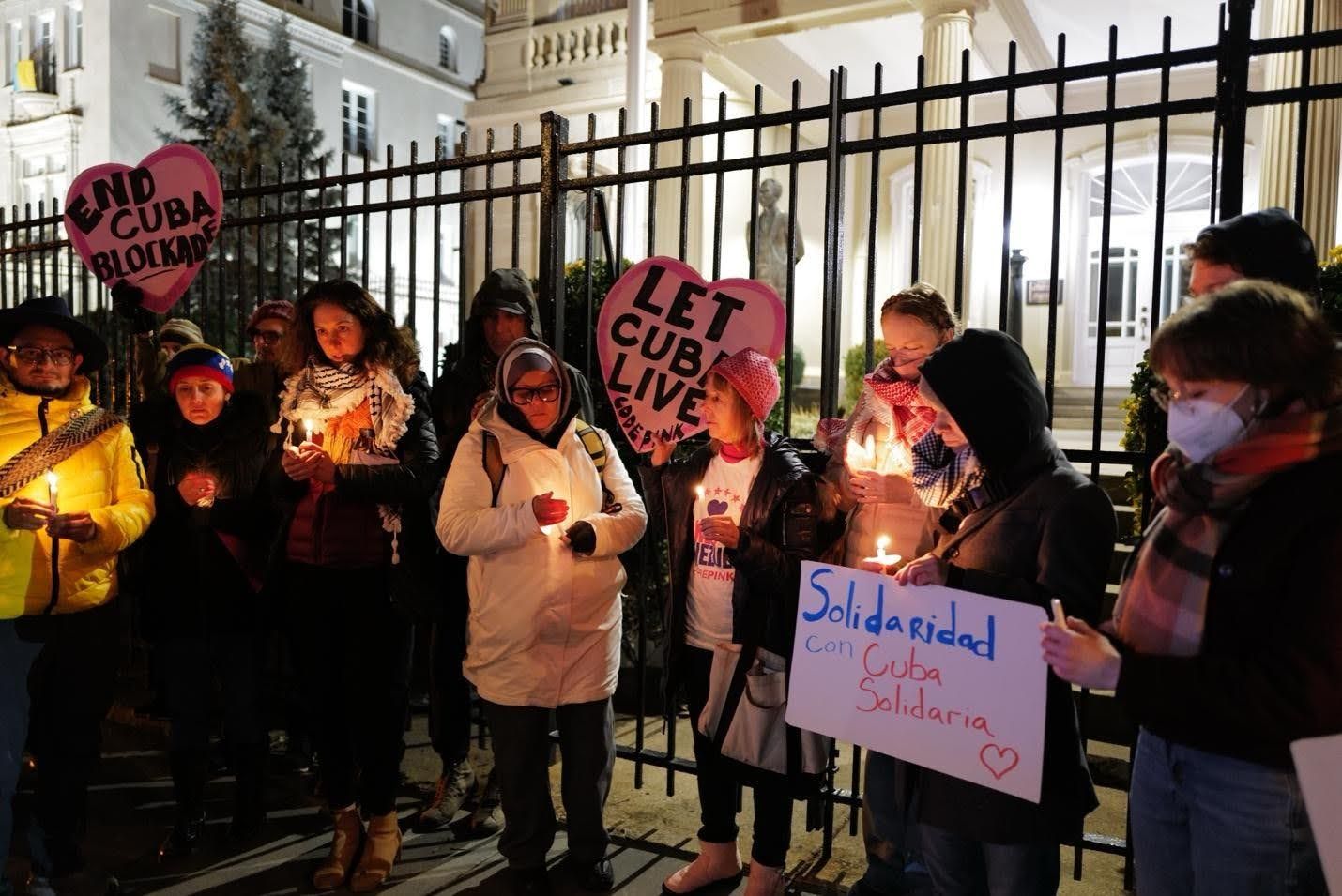
No invasion of Cuba! Statement by the League of Revolutionaries for a New America The recent indictment of 94-year-old former Cuban president Raúl Castro by a federal grand jury in Miami rests on a ludicrous allegation that Cuba poses a security threat to the United States. Castro is accused of giving the order to shoot down two U.S. planes manned by members of CIA-backed operation called “Brothers to the Rescue” that were flying unauthorized into Cuban airspace in 1996, after ignoring Cuba’s warnings not to. The United States did not pursue this until now, when a pretext to invade the island was needed. Cuba has endured over 65 years of hostility from Washington, in addition to the blockade. The biggest blow came in January, when the U.S. military invaded Venezuela, abducted its president and seized control of the country's oil industry, cutting off Cuba's chief source of oil. Thirty-two Cubans were among those killed defending Venezuela and Cuba now faces its worst energy crisis in years. Cubans have experienced some of the harshest times since the special period in the 1990s but they continue to stand in solidarity with their revolutionary socialist government and together they have survived. U.S. EMPIRE DIES HARD U.S. Secretary of State Marco Rubio’s speech at the Munich Security Conference in February quite candidly laid out a vision that held the European and early U.S. colonial world order of centuries past as the exemplar for the United States in the 21st century. Cuba has long been a thorn in the side of that mythical world order. After the defeat of the Batista dictatorship in 1959, Cuba nationalized and took over its oil and sugar industries from wealthy Cuban families and U.S. corporations that had exploited Cuba’s working poor and sent the profits abroad. The government and people wiped out illiteracy in a single year – 1961 – and developed a world-renowned system of free, universal, community-based health care. It has successfully defended its independence from imperialist domination for 67 years. The League stands for a vision of a new society and recognizes that there needs to be a government that functions in the people’s interests. The Cuban people deserve the right to determine what that means for them, just as we do here. We must stand unequivocally against our government’s efforts that threaten their existence. Published on June 20, 2026. Rally! P.O. Box 408002 Chicago, IL 60640 rally@lrna.org. Licensed under a Creative Commons Attribution 4.0 International license. Please include this message with any reproduction. in Spanish: ¡No a la invasión de Cuba! Declaración de la Liga de Revolucionarios para una Nueva América La reciente acusación contra el expresidente cubano Raúl Castro, de 94 años, por parte de un gran jurado federal en Miami, se basa en la absurda alegación de que Cuba representa una amenaza para la seguridad de Estados Unidos. Se acusa a Castro de haber dado la orden de derribar dos aviones estadounidenses —tripulados por miembros de la operación «Hermanos al Rescate», respaldada por la CIA. Los aviones volaban sin autorización el espacio aéreo cubano en 1996, tras haber hecho caso omiso de las advertencias de Cuba para que no lo hicieran. Estados Unidos no había tomado medidas al respecto hasta ahora, momento en que surgió la necesidad de un pretexto para invadir la isla. Cuba ha soportado más de 65 años de hostilidad por parte de Washington, además del bloqueo. El golpe más duro se produjo en enero, cuando el ejército estadounidense invadió Venezuela, secuestró a su presidente y tomó el control de la industria petrolera del país, cortando así la principal fuente de petróleo de Cuba. Treinta y dos cubanos perdieron la vida defendiendo a Venezuela, y Cuba se enfrenta ahora a su peor crisis energética en años. Los cubanos han vivido algunos de los momentos más difíciles desde el «periodo especial» de la década de 1990, pero mantienen su solidaridad con su gobierno socialista revolucionario y, juntos, han logrado sobrevivir. EL IMPERIO ESTADOUNIDENSE SE RESISTE A MORIR El discurso del secretario de Estado de EE. UU., Marco Rubio, en la Conferencia de Seguridad de Múnich celebrada en febrero, expuso con total franqueza una visión que tomaba el orden mundial colonial de siglos pasados como modelo a seguir para Estados Unidos en el siglo XXI. Cuba ha sido durante mucho tiempo una espina clavada en el costado de ese mítico orden mundial. Tras la derrota de la dictadura de Batista en 1959, Cuba nacionalizó y asumió el control de sus industrias petrolera y azucarera, arrebatándoselas a familias cubanas adineradas y a corporaciones estadounidenses que habían explotado a la clase trabajadora pobre de la isla y enviado las ganancias al extranjero. El gobierno y el pueblo erradicaron el analfabetismo en un solo año —1961— y desarrollaron un sistema de salud gratuito, universal y de base comunitaria reconocido mundialmente. Durante 67 años, el país ha defendido con éxito su independencia frente a la dominación imperialista. La Liga defiende la visión de una nueva sociedad y reconoce la necesidad de un gobierno que actúe en interés del pueblo. El pueblo cubano tiene derecho a determinar qué significa esto para él, al igual que nosotros aquí. Debemos oponernos inequívocamente a las acciones de nuestro gobierno que amenazan su existencia. Publicado el June 20 de 2026. ¡Agrupémonos! CORREOS. Caja 408002 Chicago, IL 60640
Juneteenth and the Unfinished Work of Freedom League of Revolutionaries for a New America The Juneteenth holiday marks one of the greatest victories in U.S. history – the end of chattel slavery, a system in which people were treated as private property with no legal rights. On June 19, 1865, enslaved African Americans in Texas learned that the Emancipation Proclamation had freed everyone held in Confederate states – a full two and a half years earlier. Juneteenth celebrates freedom won through long, deep struggle – by the resistance and work of the enslaved themselves, abolitionists of all colors, radical legislators and eventually through a bloody Civil War where approximately 750,000 U.S. soldiers died, including 40,000 Black union soldiers. Emancipation abolished roughly $4 billion in human private property – at the time, the largest concentration of private wealth in the U.S. economy. But it did not end exploitation. Private property survived, and the ruling class reorganized around new ways to exploit labor and divide workers along racial lines. The formerly enslaved received neither 40 acres nor reparations and were forced into sharecropping that trapped them in debt, alongside impoverished white workers. Meanwhile, the wealth generated by enslaved labor and stolen Indigenous land became the foundation of American capitalism and U.S. global power. Juneteenth challenges us to examine today's remaining barriers to freedom. Society has unprecedented wealth, yet millions lack access to basic needs, while a tiny ruling class turns to fascist methods to keep its dominance. As artificial intelligence and automation transform the economy, growing numbers of workers – across every race, gender, and industry – are being displaced, with no stake left in this system. The struggle for human dignity now requires the complete abolition of capitalist private property. Across the country, the victims of this system are in motion – defending neighbors from ICE, demanding healthcare and housing, protesting police violence and fighting for the right to vote. Many are angry, but don't yet see that a different system is possible today – one where the wealth we all create is shared to benefit all people and the planet, instead of hoarded by a few. Helping people envision that system and fight for it is the work of revolutionaries. Juneteenth carries a spirit of hope and transformation. It teaches that oppressive systems once thought permanent can be abolished. As we celebrate emancipation, we take up that work – building toward a society where the wealth we all create is owned in common and distributed according to need. That is the unfinished work of freedom.
The Coming Social Explosion — A Political Report on the Political Party System More and more people are beginning to realize that the AI revolution is threatening to demolish our society as we know it - more completely and drastically than any earlier economic revolution – more so than the steam engine, electro-mechanics, or even simple digital production. In February, a Citrini research report on a fictional 2028 AI-caused economic collapse caused a one-day 800-point drop in the stock market - despite the best efforts of conventional economists to refute it. History teaches us that the AI cataclysm will set off equally radical breaks in continuity in our social, political, and cultural institutions as well, including the historic US two-party political system. Indeed, they are already happening. The exact immediate outcome of the AI boom is impossible to predict, but no conceivable scenario leads to a thriving or even stable economy. Just four AI giants – Google, Amazon, Meta, and Microsoft – are investing $650 billion in capital spending in 2026 alone. That is almost four times larger than the largest automakers, construction equipment manufacturers, railroads, defense contractors, wireless carriers, parcel delivery companies, Exxon Mobil, Intel, General Electric, and Walmart COMBINED. As UVA economist Anton Korinek pointed out, they “aren’t making hundred-billion-dollar bets because they expect AI to have minor effects on the labor market.” AI investment is currently moving along two tracks. One is toward AGI (artificial general intelligence) that is designed to replace primarily white-collar workers in sectors like business, management, finance, math, architecture, and engineering. The other is toward so-called “physical AI”, the production of humanoid robots that embody AI in corporeal form. According to the Washington Post , physical AI is “fueling concerns about whether it could wipe out vast swaths of an already-devastated manufacturing sector”, not to mention transportation, agriculture, food service, and construction. Already, Elon Musk is beginning to pivot Tesla from production of cars to production of Optimus humanoids. Ruling class economists argue that increased AI productivity will sustain “aggregate demand” and grow the economy, but people with no income cannot sustain demand even if prices go down – which is not guaranteed to happen. As Bernie Sanders asked about the billionaires controlling AI, “Does anybody in their right mind think that these people are staying up nights worrying about how this transformation is going to benefit ordinary people?”\ In the unlikely event that productivity projections by AI investors fail to happen, the sheer size of the investments makes major economic disruption inevitable anyway. An MIT Media Lab study found that “AI pilot failure is officially the norm – 95 percent of corporate AI initiatives show zero return.” Not one of the major generative AI systems makes a profit today. Open AI forecasts a loss of $14 billion in 2026 and losses of $44 billion through 2029. Meta, Amazon, Microsoft, Google, and Tesla are not projected to do any better. They are burning through funds far beyond the capacities of even these economic megaliths and are depending on massive infusions of venture capital and debt. Bloomberg estimates that it will require $3 trillion to build the data centers necessary just to serve these AI systems. Each company is gambling that it will be the one to make a fortune by being first to secure a monopoly on the AI system that will eliminate the most human labor, but none of them so far have been able to find paying customers. The outcome of these investments will be either a crash based on mass destruction of jobs, or a crash based on collapse of the financial system when projects fail and debts go unpaid. Even more clearly than with earlier versions of digital automation, AI is absolutely antagonistic to the capitalist system that depends on exploitation of human labor to generate value. As the economist Korinek noted, “When a machine can do a worker’s job, the worker’s wage eventually falls toward the machine’s cost. Yes, new jobs will emerge, as they always do. But the machines will learn them faster and do them more cheaply. The reassuring historical patterns depend on humans being needed to run the economy. Remove that bottleneck, and we are facing something qualitatively different: a permanent shift in who, or what, captures the gains from economic growth.” AI AND THE TWO-PARTY SYSTEM Despite the most fervent proclamations of bourgeois economists, mass expulsion of humans from production can only decrease “aggregate demand”. Government may compensate for this for a while, with programs to create more markets, but in general the private property system cannot and will not permit substantial subsidies to meet the needs of human beings – that is a violation of its entire business model. As long as the government continues to be controlled by billionaires, it will never happen. The level of antagonism that AI is introducing into the economy today is actually sharper than the one at the root the “irrepressible conflict” that led to the US Civil War. At that time, the underlying antagonism was between slave capitalism and free labor capitalism, and no amount of diplomacy or political compromise could undo it. The inner economics of both systems required expansion into the same contested geographical territory, and the political survival of each depended on that expansion. Neither could survive without destroying the other. Today the antagonism is between a ruling class forced to defend private property, and the growing propertyless section of the working class that is becoming separated from the formal capitalist economy altogether. This section of the workers cannot physically survive without material means of support, and cannot obtain them without demanding that government distribute them based on need. They are compelled to politically attack the private property system. Today, it is either this displaced section of the working class or the private property system that must destroy the other in order to survive. One of the most important lessons of the pre-Civil War period is that major realignment of the two-party system requires a split in BOTH parties. In the 1850s, the issue was slavery – the ownership of human beings as a form of private property. The Republican Party grew out of the splintering of the Whig Party, but its victory in the 1860 presidential election would likely not have been possible without the division of Democrats into Northern and Southern sections, each with its own convention and presidential candidate The slaveocracy used John C. Calhoun’s “substantive due process” doctrine to claim that, since slaves were property, the constitution protected the slave system with no political, legal, or territorial limitations whatsoever. When the North resisted, the South launched an all-out counterrevolutionary Civil War. Despite vastly different economic and political conditions, the major ideological debate today is remarkably similar to that of the 1850s. Just as Calhoun argued that the constitutional right to own slaves trumped democracy then, today’s rulers argue that the right to private property supersedes every other right. In the 2020s, the issue has become ownership of private property itself. The antagonism in today’s economic system has already unleashed an escalating social revolution. The question is how it will be reflected in the political struggle and what will be its impact on the two-party system. The economy and a basic sense of human decency are driving more and more Americans to embrace restrictions on AI, data centers, ICE prisons, the Border Patrol, wars, genocides, and wanton destruction of the earth. The response of the rulers has been an escalating fascist offensive including Project 2025, DOGE, the mass deportation campaign, the attack on birthright citizenship, National Security memos, and the SAVE Act. Forced to choose between their hundred-billion-dollar bets on AI and tolerating democracy, the rulers have embraced fascism with a passion. The problem for the ruling class is how to impose a fascist regime on a population still steeped in the anti-fascism it learned in the twentieth century, especially during the 1960s -70s civil rights movement. THE DEMOCRATIC PARTY The basic outlines of the coming realignments are beginning to appear. In both parties, dramatic conflicts are emerging between the dominant corporate wings and their working-class bases, although in very different forms. The Democratic Party majority is clearly anti-fascist, as the No Kings demonstrations amply illustrate. Democrats who describe themselves as liberals have increased from 28% of the total in 2000 to 59% today , with millions calling themselves democratic socialists. The pro-working-class movement within the Democrats continues to steadily broaden and deepen. Some 30 House Democrats are being primaried in 2026. Candidates like Platner, Talarico, and Abdul El-Sayed are surging in the Senate races. Large cities have elected pro-working-class leaders to local office like Zohran Mamdani, Katie Wilson, and Brandon Johnson. Bernie Sanders and Rep. Ro Khanna have introduced national legislation to impose an annual 5% wealth tax on billionaires , creating a litmus test for measuring Democratic candidates, including ones for president in 2028. The tax would raise $4.4 trillion to reverse Trump Medicaid cuts, expand Medicare, and provide $3000 per person cash payments to all American families earning under $150,000 a year. But the pro-corporate Democrats who dominate the Democratic National Committee are doubling down on resistance to these working-class demands for housing, health care, public education, peace, the environment, and abolition of ICE. Since the 2008 crash, the subservience of the Democratic leadership to Wall Street banks has ruined their brand and driven their frequent electoral losses. The explosion of AI – and the potential for billions in AI profits - now adds new urgency to their scramble to preserve power. At the same time, AI offers them a new narrative to attempt to bypass their credibility gap. Pro-corporate Democrats are rallying around a new messaging strategy called the “abundance agenda”. The concept was popularized in the book Abundance by Derek Thompson and Ezra Klein in 2025. It has crystallized into an abundance movement that has raised funds, organized conferences, written articles and books, and spawned numerous lobby groups. Although purportedly nonpartisan, Thompson and Klein focus their critique primarily on the Democratic Party. Their essential argument is that Democrats should organize around creating more wealth rather than fighting over how the wealth that exists is distributed. They say that the problem with mainstream Democrats is that they are too hamstrung by government regulations to build the housing and green energy infrastructure necessary for a better future. The abundance movement is closely related to the so-called YIMBY (Yes In My Back Yard) housing movement that blames the lack of affordable housing on zoning and environmental regulations. “Inclusive Abundance” is essentially a reinvention of the trickle-down economics popularized by Herbert Hoover and Ronald Reagan, dressed up in modern “techno-optimist” language. The problem of course is that increasing abundance within a private property system only creates more billionaires at the top and more poverty, homelessness, disease, and destitution for the masses at the bottom. This is problematic enough, but the marriage of abundance ideology to the AI industry sets the stage for absolute capitulation to fascism. According to researcher Dylan Gyauch-Lewis , the “abundance gang has a big AI problem”. It turns out it is funded by AI-related tech corporations, foundations, think tanks, and trade associations. Abundance-advocated policies are not just about housing, energy, and transportation, but also for breaking down resistance to building data centers and ICE prisons. While pro-corporate Democrats pay lip service to democracy, and may even loudly denounce Trump, they are nevertheless inseparably tied to the AI industrial complex being unleashed by Trump and the Republican Party. The catastrophic impacts of AI make it fundamentally incompatible with democracy. REPUBLICAN PARTY The Republican Party is generally aligned with the pro-corporate fascist agenda, but deeply divided over the tactics of how to implement it while still retaining some semblance of a working-class base. There is a pro-Nazi wing, led by Stephen Miller, that is aggressively driving the Project 2025 program. At the same time, there is a pragmatist wing led by people that pay lip servicing to disapproving of Nazism, while supporting a kinder, gentler fascism that can suppress democracy with less of the violence that has aroused so much opposition. It may seem counter-intuitive for such pro-Israel Republicans to be allied with out-and-out Nazis, but in fact there is a long history of relationships between right-wing Zionists and Nazis dating back to the 1930s. Because MAGA depends on “blood and soil” Nazis to drive the fascist agenda, few are willing to openly condemn them. But the toxic unpopularity of Nazism forces Trump and the MAGA leaders into repeated verbal flip-flopping and ambiguity. Fascism is not just the project of a group of racist ideologues and corrupt profiteers, however. The fact is that the AI revolution is already reducing too many millions, both Democrats and Republicans, to destitution. The economy is already beginning to tear the MAGA base apart. AI cannot proceed within a private property system without a fascist corporate dictatorship. Corporate dictatorship is impossible without eliminating or severely restricting the right to vote. And voter suppression is impossible without racial and other political campaigns against literally every population subgroup, real or imaginary, that can be separated out and attacked. The history of so-called “Negro disenfranchisement” in the South from 1890 to 1910 is instructive. “In Virginia the average vote cast for Congressmen declined about 56 per cent between 1892 and 1902,” wrote historian C. Vann Woodward . “In Alabama the decline was 60 per cent; in Mississippi, 69 per cent; in Louisiana, 80 per cent; and in North Carolina, 34 per cent. Of the states relying on the poll tax or the white primary, the decline was 69 per cent in Florida, 75 per cent in Arkansas, 50 per cent in Tennessee, and 80 per cent in Georgia.” Although the Southern disenfranchisement campaign very deliberately and specifically targeted African Americans, its corporate sponsors were more than happy to cancel voting rights for the millions of Southern working-class whites who also could not afford poll taxes or pass literacy tests. Indeed, consolidating the Jim Crow system required extending repression to every segment of the working-class. Similarly, the real danger of today’s SAVE Act, and the campaign against birthright citizenship, is that their actual targets are not just undocumented people, as they claim, but rather the rights of the ever-increasing categories of people that the dictatorship intends to marginalize as it consolidates its power. The fight against fascism demands that we build working class unity, step by step, across every occupation, region, demographic, and ideology. The epic Minnesota uprising points the way. Unity begins with the most impacted and will work its way outward into the broader sectors of society. War, inflation, and basic needs budget cuts are driving more and more people into the resistance. WAR ON IRAN Every one of these divisions within the two major parties has been intensified dramatically by the US war on Iran. There has NEVER been so much opposition by the American people to a US war at its outset as there is now. In addition to once again threatening survival of the planet with nuclear warfare, it is creating massive environmental damage, and unnecessarily endangering the lives of millions of Iranian civilians and even US troops. It is costing billions of dollars and dramatically raising gas and food prices, not only overseas but here in the US, for both Republican and Democratic voters. As a result, it is ratcheting up polarization within both the major political parties. On April 15, the largest number of Senators ever voted against sending weapons to Israel (36) - including over three-quarters of Democratic Senators. At the same time, the pro-corporate Democratic National Committee refused to cut its ties with the billionaire pro-Israel AIPAC lobby. The war is so unpopular that anti-war sentiment has broken out even inside the Republican Party. Major MAGA influencers have spoken out boldly against the war, not because they have changed their fascistic views, but because the impact of the war is so badly hurting the working-class sections of the MAGA base. As a result, there is a possibility that a section of Republicans may break off and join Democrats to invoke the War Powers Act, when its 60-day deadline for Congressional approval expires on May 1. The convergence of all these factors creates a significant opportunity - unprecedented since the Vietnam War - to unite a broad movement against the militarism of the ruling class. Strengthening the peace movement will be one more step toward independence from the two-party system, and creation of an anti-corporate, left wing third party where workers can fight more effectively for political power against the billionaire class. It is one more opportunity for revolutionaries to address the economic distress and moral outrage of the workers and deepen their social and class consciousness. CONCLUSIONS ONE. The League needs to reaffirm the assessments it made and tactics it projected from 2010 to 2018 around the motion toward a third party. Just because a third party has not yet emerged does not mean these assessments and tactics were wrong. In fact, the growth of AI makes those assessments more relevant and more urgent than ever. The following are quotes from Rally articles written in those years. “Historically the working class has been politically tied to the capitalist class through the Democratic Party. Today, the Democratic Party remains the glue that ties the workers to the capitalists politically. That’s why the League’s strategy is to throw the blow at the middle — the Democratic Party — to break that connection as a first step towards the development of working-class political independence. “Is the development of a third party a blow that strikes at this middle? It is, and revolutionaries should welcome and embrace motions towards a third party. As workers are increasingly thrown out of the production process and out of the capitalist economy, the subjective political ties are beginning to fray and break. The process is accelerated with the development of a third party, which becomes a new environment and school for political independence from capitalist rule. “This third-party motion has one foot inside the Democratic Party pushing it to do the right thing, with the other foot outside, discussing the need to create new reformist political parties to the left of the Democratic Party. The third party is an indispensable stage in the revolutionary process. It is a necessary and inevitable step toward a workers’ party. “An anti-corporate, left wing third party will serve simultaneously as an instrument for the ruling class and for workers. The rulers will use it to attempt to contain the movement and retain its political control. The workers will use it to attempt to unite and politicize their battles for basic needs. “Revolutionaries who participate in the development of an anti-corporate, anti-fascist third party will influence it by pulling together a working-class trend within it. The stronger the working-class trend, the stronger the third party. It is crucial to influence the consciousness of the revolutionaries involved in the process. Political polarization will develop from this engagement over ideas, strategy and direction: polarization that will lead to a true workers party and a separation of class interests.” The Democratic Party contains a powerful and growing anti-fascist, pro-working-class current — but that current is in direct conflict with the corporate wing that still controls the party apparatus. The Republican Party leadership has been fully captured by the billionaire fascist offensive. Neither party, as currently constituted, can deliver what the working-class needs. We have to begin now to build the independent organizational infrastructure, programmatic clarity, and class unity that a working-class party will require. Support primary challenges to corporate Democrats. Build candidate pipelines grounded in working-class principles. Carry on political education that connects the present campaigns with the ultimate aim of creating a working-class party. TWO. The League needs to reaffirm the tactic of focusing where the movement for basic needs enters the political arena. The movements of the unsheltered, housing-insecure, and poor are not peripheral to the class struggle — they are its leading edge. Our work must deepen unity among these sectors, connect their demands to electoral formations and the broader political realignment taking shape, and center the demands for basic needs in electoral strategy and candidate accountability frameworks. Connect poverty and housing insecurity to AI-driven job displacement, wage stagnation, and the collapse of public services under AI-driven austerity. Raise the basic needs agenda inside the No Kings movement. THREE. Be nimble enough to respond to fascist coup attempts in Nov 2026 and 2028, including attempts to seize ballot boxes. Fight to block the SAVE Act and block repeal of birthright citizenship. These are the key pillars of the dictatorship - attempts to reinstate the Dred Scott decision that says nonwhites have no rights in the Constitution or Declaration of Independence. Expose the connection between billionaire AI ownership and the gutting of civil rights, labor rights, women’s rights, and democratic freedoms. Connect the growing resistance of women —to economic insecurity, political exclusion, and loss of reproductive rights — to the broader anti-fascist resistance, and use these connections to drive voter registration and turnout. FOUR. No more blood for oil, no funding for war and genocide. The same billionaires that profit from AI are the ones driving the wars, occupations, and the genocide of the Palestinian and Iranian people. The proposed trillion-and-a-half-dollar military budget has nothing to do with safety and everything to do with cutting basic needs and subsidizing AI investments. There is no separation between the fight for economic justice and the fight against imperial violence. FIVE. Work with the emerging working-class urban political movement that is already winning office, and putting forward transformational governance models. These victories are not isolated — they are the early expressions of political realignment. Elevate, connect, and learn from these models as proof of concept, and use them to build the political will for the deeper transformation we know is necessary. Public wealth for public good is not just a slogan — it is a governing framework that is winning in the real world. Develop political education curriculum connecting these local victories with the national movement to challenge private property supremacy and assert the people’s right to public wealth. Build solidarity. AI requires a massive infrastructure of data centers, consuming land, water, and energy in communities already overburdened by poverty and pollution. At the same time, ICE concentration camps are expanding alongside the deportation machinery. The movement to oppose new data centers and close ICE camps is an essential opportunity to expand the movement, especially into rural and semi-rural areas. THE MOMENT DEMANDS EVERYTHING WE HAVE The AI revolution is not just disrupting the economy — it is cracking open the political system, forcing into the open the irrepressible conflict between the billionaire class and the working-class majority. The question is not whether a new political formation will emerge. The question is whether it will be one that is shaped by a conscious, organized, working-class movement — or one imposed from above by a fascist oligarchy. The League's mission is to unite with other revolutionaries around the demands of low-income and displaced workers, and show how the solution is a cooperative society, where social wealth is owned in common and products are distributed according to need. The coming social explosion can be the birth of a new society. Our work is to make sure it is.
Statement from the League of Revolutionaries for a New America In the early hours of February 28, 2026 President Donald Trump gave the green light to Israel to attack Iran. By evening the largely civilian casualties in Iran number in the hundreds, many of them children. The U.S. spent weeks sending the largest Naval fleet to the Persian Gulf since its 2003 invasion of Iraq. Despite Trump’s hollow rhetoric about negotiations, which were always contradicted by Benjamin Netanyahu’s stated intentions and Trump’s own threats, Iran was prepared for a war and vowed to strike back at Israel and U.S. bases in the Gulf region, which it did promptly. As of this statement Iran is closing the Strait of Hormuz. If the effort is successful, repercussions will be felt globally. About 20% of the global oil supply passes through the straits. The U.S., joined at the hip with Israel is at war with the Islamic Republic of Iran. With the confirmed killing of Iran’s supreme leader, escalation is assured and the cost in human lives will be dear. War with Iran is condemnable on its own, but the economic and political fallout will be the enduring legacy to the American people and should be a clarion call to all revolutionaries to act in the interests of our class. In the U.S., every indicator of well-being is declining, and every measure of destitution is increasing. This crisis does not unfold in isolation from the war economy being unleashed abroad — both are expressions of the same dying system. The Trump administration displays the depravity and the desperation of the ruling class he represents, hostile to the concept of democracy and any vision that does not maintain their rule. How are we to make sense of the immorality of deliberate targeting of Iranian civilians, including a girl’s elementary school, killing over 150 children? We are seeing once again the historical link between war and fascism at home and war against the world. The people of Iran united against imperial aggression in the face of their own internal struggles. Revolutionaries in America can and must unite if we are to work toward a society in which we can thrive and establish peaceful coexistence. To reach the League, visit https://lrna.org/ To read the League’s bilingual newspaper, visit https://rally-theleague.org/
This report was presented in four parts and discussed in the NC’s regular meeting in December 2025 and at a special weekend retreat In January 2026. As you read the the four parts of this report below), please keep in mind these discussion points: • Fascism is NOT a done deal - it can be stopped. • Fascist forces are not just confined to MAGA/MAHA • Elections are a very important part of the the working class’ response to fascism but alone, elections will not stop the fascist drive • The transition period, the epoch of revolution that we’re in, requires the end of capitalism and private property to not only stop fascism but begin a new a path toward communism and literally save our lives, other species and the earth we love and sustains us. Chaotic, difficult, challenging and tumultuous periods of history offer us the most powerful conditions for revolutionary transformation. 1. Economy and State On September 30, Donald Trump told the 800 generals in an unprecedented assembly convened by Defense Secretary Hegspeth that deployments in U.S. cities are “going to be a big thing for the people in this room because it’s the enemy from within and we have to handle it before it gets out of control.” Something big is happening in this country. Calling it “fascism” might be correct, but to identify the responsibilities of revolutionaries, we have to look more specifically at what is happening and dig deeper about why Project 2025, the Democratic Party’s failure/inability to mount a campaign that spoke to the needs of the people of this country, Trump in the White House — all these are part of the picture. There are deeply rooted historical and current causes. There are also preparatory precedents, like the 1981 passage of the Military Cooperation with Law Enforcement Act that integrated the US military into domestic drug enforcement and then the regular supply of military equipment to local police departments. Soldiers and police trained together and conducted joint paramilitary operations. economic revolution…. But to understand why now? and to know what is to be done? we have to understand where it’s coming from. We need to look at it more deeply and in an economic and historical, global and domestic context, The first thing is that US society is disrupted at its foundation. The people of this country and the world are well into an economic and social revolution. The labor-displacing capacity of computers, robotics, AI, etc has brought about an economic revolution that is disrupting and de-stabilizing States and societies organized around industrial production. Ideas, institutions, and relationships that used to hold US society together no longer do so. Jobs and incomes that used to stabilize life for a critical section of society are simply no longer available. Although the forms and outcomes may be uncertain, this economic revolution is bound also to manifest in social upheaval. Political direction and outcome are not clear. We are familiar with how this economic revolution has un-folded in the US. Beginning in the 1970s and 1980s, the economic revolution began replacing millions of US workers in large-scale industry with robots. Digital technology made it possible to off-shore millions more jobs that became part of a global system of production. Over the last four or five decades this expulsion of millions of workers from their connection (in production) with the capitalist class began to disrupt society at its foundations. Everything that was built on that connection — public education, public health, affordable housing, an electoral-party system — came to be undermined. That was just the beginning of the disruption of society — the beginning of the end of the connection of capitalists and workers in the process of production, i.e., relations of production. Ever more sophisticated artificial intelligence now threatens to displace many more millions. This break in the relation of the working and owning classes also adds political energy toward legal and political changes that promote the accumulation of “wealth” beyond typical labor vs capital relationship. These new forms [?] of private property beyond capitalism are beginning to shape society. These forms may rest on capitalist exploitation, but they are ever more remotely based in actual production and employment — hedge funds where investors speculate on the ratio between occupied and unoccupied housing, how fast glaciers are melting, billions of dollars of speculation in crypto-currency, etc. We have referred to this broken connection between classes in production as an “antagonism at the economic base of society.” The State is no longer rooted in a stable connection between the working class and capitalist class. Objectively, the imperative of government — to ensure that workers are healthy and educated enough to come to work everyday — is declining. Its role shifts ever more rapidly to coercion. All this is bound to bring about a change in how the ruling class exercises its power. And now we are seeing it. Donald Trump and his associates came into office hollowing out government and making changes in the State/form of rule that corresponds to the changed needs of the ruling class. They are the messengers, not the underlying cause. These are political effects of the economic revolution. By just about any definition, the lying, terroristic, precedent-setting brutal form of rule being imposed by the Trump Administration can be considered fascistic. This definition was used to understand the fascism of the last century: “The accession to power of fascism is not an ordinary succession of one bourgeois government by another, but a substitution of one state form of class domination of the bourgeoisie -- bourgeois democracy -- by another form -- open terrorist dictatorship.” (Dmitrov) Although many of the events of the day look similar to the German and Italian fascism of the 20th century, the definition doesn’t tell us what’s happening now in this country, at this time and why. Fascism of the last century came about in the transition from economies and work rooted in agriculture and small-scale manufacture. Fascist “leaders” in the 20th century agitated popular anger and discontent after WW1 and a sense a loss of place in a society that was undergoing huge changes at its economic foundation. Those who were able to find their way to political power did not implement any sort of program that addressed the needs and anger of the people in that moment. Instead, their regimes shaped political and social superstructures that supported and accelerated industrialization and the growth of capitalist production relations in their respective countries. That was the historical purpose of 20th century fascism. Today’s fascism has a different purpose and program. It does not aim to develop industry and support capitalist production relations. It aims to support and prolong other forms, relationships, and investment schemes that depend ever more remotely on production, while preserving private property relations. In this sense today, the motion toward fascism today is a political expression of the social revolution that began with robots replacing factory workers. The extent of the legal and political changes that suit the needs of the ruling class (and the private property relations they represent) may not be obvious. But for several decades, at least, some analysts for the ruling class have described the legal changes that erode the responsibility of the State/government to care for its people. In 2003, Philip Bobbitt, a professor of constitutional law at Columbia University, wrote a book whose conclusions were applauded by business leaders. The book is over 800 pages long, and he uses his own complicated terminology, but the “Forward” to the book (by another scholar) summarizes Bobbitt’s thesis: “So as the development of guns had destroyed the old feudal order, and the development of railways the old dynastic order, now the development of computers has destroyed the nation-state. Not the State itself, as Bobbitt is at pains to show: the State will always be necessary to provide security, fiscal organization, and law. But in the same way as princely states mutated into dynastic territorial states, and they in their turn into nations state, now, nation-states are mutating into what Bobbitt terms ‘market states’….” (Page xviii.) In a nutshell, Bobbitt points to the end of what he calls the “nation-state,” which protects the entire nation — to some extent, at least — and its replacement by the “market-state” that “pursues its objectives by incentive structures and sometimes draconian penalties, not so much to assure that the right thing is done as to prevent the social instability that threatens material well-being.” (P 229) Bobbitt is explicit about this “market-state.” • “The revolution in information technology that has so empowered non-governmental groups cannot function in a non-state environment…. It is the national-state that is dying, not the State. With it will go much of the power and influence of the great international institutions of the society of nation-states, institutions like the World Bank, the United Nations, the International Court of Justice. This void will be filled by institutions and rules that reflect the new society of market-states; when this order changes, as is now happening, the institutions of the society composed of states inevitably changes also.” P 363-64. • “The market-state is largely indifferent to the norms of justice or for that matter to any particular set of moral values so long as the law does not act as an impediment to economic competition…” (p 230) • “In the market-state, the State is responsible for maximizing the choices available to individuals. This means lowering the transaction costs of choosing by individuals and that often means restraining rather than empowering governments.” (p 230) • “In the market-state, the marketplace becomes the economic arena, replacing the factory. In the marketplace, men and women are consumers, not producers (who are probably offshore anyway).” (p 230) We should note that Bobbitt didn’t simply advocate these changes. He described how the political superstructure changes to promote the interests and continuity of private property relations under the new conditions shaped by technology that displaces labor and workers. Whether or not they read Bobbitt’s 800+ pages, the ruling class is moving on its conclusions — in business schools at elite universities, at the Heritage Foundation, in lobbying arms of Wall Street banks. They have political power, so they don’t have to announce these things to the general population. But they know what they need and how to get it. what the ruling class/business needs. The ruling class does not need to preserve capitalism. They need to protect private property under new conditions. Bobbitt described the type of changes to the political superstructure they need. The Trump Admin seems to be heading in that direction. He is simply talking louder and running faster on the same path: But the legal changes that support money being made of off money go back decades: - In the late 1980s through the early 2000s, there occurred what a former chief economist for the World Bank called a “quiet coup” in this country. A reckless deregulation of the financial sector cleared the way for new financial products: credit default swaps, securitization, financial derivatives, commodity derivatives, irresponsible loans. All amounted to financial investors’ speculation – bets – on interest rates and various forms of debt. Whether or not the debts get paid, the financial investors make their money – based ever more remotely on the actual production of homes, cars or whatever the loans were taken out for. - Then the repeal of the Glass-Steagall Act in 1999 cleared the path for financial institutions to control the majority portion of key industries and infrastructures. In 2000, to “modernize” and “enhance the competitive position of United States financial institutions and financial markets,” the Commodity Futures Modernization Act (CFMA) cleared the way for all sorts of new speculative products, many of which we still see rolling out today. - After the inevitable financial crash in 2007-08, the 2008 bailout and restructuring of the financial sector was the largest ever transfer of public wealth to private interests. The cost to the Federal government amounted to $15,000 per man, woman and child in the U.S. In the first half of 2009, the top six banks got $30 billion in profits. Trump’s hollowing out of public education stands on that history. His “Big, Beautiful Bill” is poised to accelerate the privatization of the nation’s school systems — and private equity aims to cash in. By some estimates, the law’s new school voucher provision — which uses public funds to help parents pay for private-school tuition — is expected to transfer anywhere from $4 billion to $51 billion to private schools and companies that contract with public school districts. That includes companies owned by private equity firms.” https://www.levernews.com/private-equitys-new-playground-americas-schools/ Despite the decline in real wealth production in the US, investors still want to invest — somewhere, somehow to fill their coffers. And so we see the predominance of financialization of basic social needs, along with speculation on interest rates, future prices, housing supply and vacancies, etc. All this amounts to stronger bonds of debt for the working class. Now AI and other high-tech ventures are getting regulations and de-regulations that not only threaten to crash the economy but also add to the devastation of Nature. Trump and his family are deeply involved in crypto-currency, another by-product of high tech and financialization of the economy. The state of Wyoming proudly pledges no regulation on crypto. All a crypto-company needs is a WY address, so thousands of crypto companies are registering there. So many companies are “moving” to Jackson Hole, WY that housing there is now unaffordable for the few workers who are left there. The military industry thrives off of war — including the international sales of weaponry and the growing domestic operation of both the military and the police. The high-tech industry long ago dropped any hesitations about offering its capacity to the military. And now they are heavily invested and wildly profiting. All that is not to say that what is happening is the cause of what is happening. Changes at the economic foundation of society have made possible new avenues of profiteering. Then, at a certain point, bigger and broader political change starts to reorganize society according to the needs of these new forms of private property — as predatory and rapacious as they are. The Trump Administration’s hallowing out of government and disregard for human life are perfectly compatible with investors in these growing sections of the economy. Although these changes meet the specific needs of certain sectors of the economy, there are no other sections of the ruling class that have an different agenda that is compatible with any programmatic or practical needs of the working class. The relative weakness of the US in the emerging multi-polar world order also shapes the political needs of the ruling class. We are seeing the beginning of the end of US dominance in the world — a dominance based on slavery, genocide, and colonialism. French anthropologist and author Emmanuel Todd noted that…. The inevitable defeat in and withdrawal from Ukraine ”will have dramatic consequences for the Empire that those from Vietnam, Iraq or Afghanistan did not have. This is indeed the first American strategic defeat on a global scale in a context of massive deindustrialization in the US ….” The ruling class needs lies to keep the population in the dark. They need division and repression to keep it from uniting to fight in their own interests. The twin horrors of war globally and the inevitable and sharp declining standard of living in the US present to US revolutionaries some heavy responsibilities. It also presents the opportunity to develop the political consciousness of our class. This moment calls on us to speak out against the crimes of our ruling class against the people of world. This beginning of the end of US dominance presents the responsibility and the opportunity to overcome the national chauvinism that has prevented our working class from thinking and fighting in its own actual interests — with consciousness of its actual interests and united against its ruling class. The incomes and privileges enjoyed by a significant section of the US working class came at the expense of millions of oppressed people elsewhere in the world. That relatively privileged position of workers in the imperialist core has crippled the revolutionary movement for over 100 years. The geopolitical situation today holds the potential to bring that chapter of history to a close. The blocks to that unity and consciousness go back to the origins of this country — founded on genocide, colonialism, and slavery. The beginning of the end of US dominance in the world holds the potential for the unity and consciousness of our class. Accomplishing that potential depends on the thinking and work of revolutionaries. **This economic revolution and the social effects are being fought out politically, in forms particular to time and place. Nationalism is an ever-present component of fascism. In this country, that nationalism is shaped by US history of the colonial status of the Black Belt region of the South and the legal and extra-legal violence and oppression of the African-American people — with a continuity, though in evolving forms — from slavery through to today. More specifically, the Jim Crow regime imposed on the South (after the Civil War and the violent overthrow of Reconstruction) shapes how the ruling class exercises its political power to this day. They rely on the oppression of the African-American people to control the working class as a whole.** 2. US history and political power The American Roots of Fascism Amidst Economic Upheaval The accelerated drive toward fascism during these disruptively changing economic conditions represents a fundamentally new crossroads in human history. The pace at which the economic base is shifting has intensified the push toward fascism. At the heart of maintaining capitalist relationships in the U.S. is violent white supremacy. The George Floyd demonstrations of 2020 and the growth of a 21st century abolition movement was a social expression of economic upheavals accompanied by requisite oppression. The threat that millions of working class people of all nationalities and genders posed by protesting police violence was not lost on the authors of Project 2025. History doesn’t repeat itself, but it does carry a living legacy. That living legacy is American fascism born out of the Defeat of Reconstruction. It embraces the violent white supremacy that was necessary to enforce the slave codes before the Civil War (Dred Scott, 1857): The Black Codes during the immediate aftermath of the Civil War (1865): and finally, the formal defeat of Reconstruction with the legal construction of white supremacist Jim Crow in Southern States (Hayes-Tilden 1877).* Fascism is not new to America. Reconstruction Period Dubois characterizes the period immediately following the Civil War as “anarchy in the South and the triumph of brute physical force over large areas”. There was no civil authority in most southern states. The slave owning planters’ class had lost control of Congress. Starvation and violence permeated the region. The federal government was in turmoil. What would the content of democracy be as political power shifted from the planter class to industrial and finance capital? Who held the power; Congress, the President and/or State Legislatures? Southern states answered with the Black Codes - slavery by another name. Vagrancy laws; denial of freedom of movement and property ownership; sundown laws; and the continuance of Dred Scott’s (1857) ruling that Blacks were not citizens and had no rights that a white man was bound to honor were the grist of American fascism and enforced by violence both ‘legal’ and sanctioned ‘extra-legal’. Reconstruction from 1865-1876 was marked by 1000’s of lynching with brutal massacres of formerly enslaved people that included whole families and communities. There was also a terrifying randomness to killings for no discernable cause.’ https://eji.org/reports/reconstruction-in-america-overview/. The randomness of violence that marked the Black codes are mirrored today in the kidnapping, torture and detention of immigrants. 71% of those detained have no criminal conviction, reflecting a living legacy of isolating, control, and illegality. The aim of the white supremacist terror was to prevent formerly enslaved from political participation and keep them tied to land, in the mines and in the kitchens in slave like conditions. Over 2000 lynchings were documented during Reconstruction and thousands more unknown, beaten, whipped, raped and tortured. The convict leasing system that began immediately after the Civil War is imprinted on today’s prison industrial complex. The ‘slave patrols’ followed by white militias & KKK were the origin of American policing. The murders of Ahmaud Arbery in Brunswick, GA and Trayvon Martin in Sanford, Fl., are directly linked to that violent ‘extra-legal’ terrorist white supremacy. Vagrancy laws that filled the prisons are not unlike today’s criminalization of the homeless, mass incarcerations, and immigrant ICE detentions. The Reconstruction period from the general strike of slaves who left the plantations and gave their labor to the Union securing the latter’s victory; through the passage of the 13th, 14th and 15th Amendment was a constant battle. The establishment of the short-lived Freedman Bureau and its work to assist the formerly enslaved and poor whites with food, clothing, and shelter was a brief moment in time. Yet despite the violence, hospitals and schools were built laying the foundation for a public school system. Project 2025 today makes clear its intent is to end the legacy and origins of any governmental role other than policing, ICE and military. Jim Crow: The Subordination and separation of Black people in the South – codified and enforced by custom, habit and violence. * (from the Equal Justice Initiative) “Now that political power had been regained, legalized racial subordination could and would be restored. “[I]f we would have white supremacy,” Knox explained, “we must establish it by law—not by force or fraud.”93 From 1885 to 1908, all eleven former Confederate states rewrote their constitutions to include provisions restricting voting rights with poll taxes, literacy tests, and felon disenfranchisement.” (Equal Justice Initiative). https://www.historians.org/perspectives-article/if-anybody-says-election-to-me-i-want-to-fight-the-messy-election-of-1876-october-2020/ . The Hayes-Tilden compromise of 1877 formalized what was already well underway. It was in the interest of Northern industry, railroads and finance to enact the ‘compromise’ that imposed colonial conditions on the Black Belt South and protected capitalist private property through segregation. “To the editor {of the National Republican} it appeared but natural and proper that the ‘governing classes’ in the South should combine with like elements in the North against Northern Democratic ‘riff-raff’ and assume leadership over ‘the native menial classes’ of the South…” (Origins of the New South by C. Vann Woodward). Multiple court cases and unmitigated racial mob violence in the 1870’s and 1880’s mortality wounded any legal equality or protection delineated in the Reconstruction Amendments. The final withdrawal of federal troops from South Carolina, Louisiana, and Florida guaranteed the super exploitation and violent control of Black labor in the South. The following decades used the State Rights’ Doctrine enshrined in the defeat of Reconstruction to crush working class unity with both terror and laws like Taft Hartley, right-to-work. Attempts by Black people to exercise the right to vote or to challenge the total control that landowners exerted over sharecroppers were met with brutal and often deadly violence. Efforts to escape the confines of the plantation system or to assert basic freedoms provoked retaliation, serving as a warning to others. Fascism is not only ‘mob’ violence, but legally sponsored and sanctioned state violence. Over 4000 lynchings occurred in the South between 1877-1950. “Terror lynchings were horrific acts of violence whose perpetrators were never held accountable. Indeed, some public spectacle lynchings were attended by the entire white community and conducted as celebratory acts of racial control and domination.” Fast forward to the repeal of preclearance under the Voting Rights Act, the destruction of DEI programs, and SCOTUS’ favorable rulings to all of Trump’s ‘shadow dockets’, and a clear path emerges for Project 2025’s agenda. The seeds of Plessy v Ferguson are unmistakable. The State of Georgia has purged over 500,000 people from the voting roles and instituted multiple obstacles to voting including reducing drop boxes, requiring multiple identifications to request an absentee ballot, closing well over 1200 voting polls and gerrymandering that virtually guarantees ultra conservative candidate wins. The transparency of the social base for terror, violence and intimidation was on full view with the threats against two Black women election workers in Georgia in 2016. “Death threats from angry Trump supporters forced Georgia election worker Ruby Freeman, a 62-year-old grandmother, to flee her home of 20 years. Some messages called for her hanging; one urged people to “hunt” her. Freeman showed hundreds of menacing messages to police and called 911 three times.” The drive toward consolidating fascism today follows the same agenda as the institution of Jim Crow 148 years ago: white supremacy as the form and fascism as the content. At this moment, xenophobia is the racist tool and patriarchy it’s hammer. The super exploitation and oppression of the Black, Indigenous and immigrant worker has never stopped but the possibility for working class unity is far greater today. Over 60 years of lessons and struggles for ‘reforms’ have shaped expectations and a powerful but incomplete movement for social and economic justice today confronts the capitalist roots of fascism and the urgency that global warming imposes. Conclusion: Mussolini may have coined the word, ‘fascism’, but the origin is here in the U.S. South. The Jim Crow South was the open terrorist dictatorship of capital. Understanding this history gives us the tools to strike blows against fascist consolidation and instructs us on the keystone for developing class conscious unity. In 1877, there was a shift in a dominant section of the ruling class from planter to industrialist & financier. The dominant forces of production shifted from agricultural to industry. Another shift in the productive forces is underway now (from industrial to electronic & digital), but so far, there is ruling class political unity. What confronts us now is not the scarcity of the Civil War times but class war to end this rotten, degenerate system and equitably plan and distribute resources as needed and necessary to heal our wounds and the earths. 3. Is Fascism Growing in the United States? A Documentation of the Evidence (2020-2025, with few earlier examples) Introduction: The Question and Framework Is fascism developing in the United States? This report examines the evidence using the League of Revolutionaries for a New America's analysis: "Fascism today is the step-by-step, law-by-law, precedent-by-precedent changes to the legal superstructure that favor financial investments." The League identifies fascism as the merger of corporate power with the State, the weaponization of white supremacy to divide workers, the criminalization of those the economic system no longer needs, and the turn to "naked force and violence" when traditional control methods fail. The evidence documented here—spanning Supreme Court decisions, federal and state legislation, executive actions, and government enforcement practices—reveals a clear pattern: systematic dismantling of democratic rights, escalating state violence, and the construction of a legal apparatus designed to protect private property while suppressing dissent and criminalizing poverty. The trend accelerates dramatically from 2020-2025, demonstrating not isolated incidents but coordinated transformation. The answer is yes. Fascism is growing in the United States. Here is some evidence. I. THE SUPREME COURT ENABLES FASCIST ADVANCE The Supreme Court has systematically dismantled protections and enabled authoritarian state power through a series of decisions that concentrate around 2013-2024, with a 6-3 conservative majority driving the recent acceleration. Voting Rights Gutted (2013) Shelby County v. Holder - 5-4 conservative majority · Struck down Section 4(b) of Voting Rights Act, eliminating federal preclearance requirement for jurisdictions with history of discrimination Office of Public Affairs The Enduring Work of Protecting Voting Rights: 59 Years and Counting · Section 5 had blocked discriminatory voting changes nearly 1,200 times before Shelby Office of Public Affairs The Enduring Work of Protecting Voting Rights: 59 Years and Counting Result: Nearly 100 restrictive voting laws passed since 2013, with 29 states enacting restrictive measures States Have Added Nearly 100 Restrictive Laws Since SCOTUS Gutted the Voting Rights Act 10 Years Ago | Brennan Center for Justice. The floodgates opened. Poverty Becomes a Crime (2024) City of Grants Pass v. Johnson - 6-3 conservative majority · Ruled cities don't violate Eighth Amendment when criminalizing sleeping outside even if no shelter space available The Supreme Court Rules on Homelessness: What it All Means - National Alliance to End Homelessness Result: Within months, roughly 150 cities in 32 states passed or strengthened camping bans Many more cities ban sleeping outside despite a lack of shelter space • Stateline. Over 320 bills criminalizing unhoused people introduced in past year, nearly 220 passed One Year Since Grants Pass: Tracking the Criminalization of Homelessness | American Civil Liberties Union. Women's Bodies Under State Control (2022) Dobbs v. Jackson - 6-3 conservative majority · Overturned Roe v. Wade, eliminating 50 years of constitutional protection · Reinstated "states' rights" doctrine allowing state control over reproduction Racial Equity Eliminated (2023) Students for Fair Admissions v. Harvard - 6-3 conservative majority · Banned affirmative action in college admissions · Became justification for sweeping attacks on all diversity programs The Pattern: Every major decision enabling fascist policies comes from conservative Supreme Court majorities. The Court systematically removes protections for voting rights, bodily autonomy, racial equity, and basic survival, while expanding state power to punish and control. II. 2020: THE TURNING POINT - FEDERAL TROOPS AGAINST AMERICAN CITIES The summer of 2020 marked a dramatic escalation: the federal government deployed military-style forces against American cities, often over the explicit objections of local officials. This was unprecedented in modern American history. Lafayette Square: Tear Gas for a Photo (June 1, 2020) The Attack: · U.S. Park Police and National Guard troops pushed peaceful demonstrators out of Lafayette Park using tear gas so President Trump could walk to St. John's Church for photo with Bible Peaceful Protesters Tear-Gassed To Clear Way For Trump Church Photo-Op : NPR · Former minister Gini Gerbasi: "We were literally DRIVEN OFF with tear gas and concussion grenades and police in full riot gear. PEOPLE WERE HURT SO THAT [President Trump] COULD HAVE A PHOTO OPPORTUNITY" Peaceful Protesters Tear-Gassed To Clear Way For Trump Church Photo-Op : NPR The Threat: · Trump delivered speech urging governors to use National Guard to "dominate the streets," or he would "deploy the United States military and quickly solve the problem" Donald Trump photo op at St. John's Church - Wikipedia Military Deployment: · Active duty troops stationed in capital complemented roughly 5,400 guardsmen from D.C. and 11 other states Donald Trump photo op at St. John's Church - Wikipedia · Governors of Virginia, New York, Pennsylvania, and Delaware declined requests to send National Guard troops to District of Columbia Donald Trump photo op at St. John's Church - Wikipedia Portland: Secret Police in Unmarked Vans (July 2020) Kidnapping-Style Arrests: · July 15: Video recorded showing unidentified armed individuals wearing camouflage fatigues physically apprehending demonstrator and taking him away in unmarked van 2020 deployment of federal forces in the United States - Wikipedia · Mark Pettibone, 29: "I was terrified. It seemed like it was out of a horror/sci-fi. It was like being preyed upon" Federal Officers Use Unmarked Vehicles To Grab People In Portland, DHS Confirms : NPR · Pettibone taken to federal courthouse, placed in holding cell, never told why he was being held or provided any record of arrest Federal Officers Use Unmarked Vehicles To Grab People In Portland, DHS Confirms : NPR Federal Forces Without Identification: · Federal officers used unmarked vehicles to drive around downtown Portland and detain protesters since at least July 14; videos show officers driving up to people, detaining individuals with no explanation, and driving off Federal Law Enforcement Use Unmarked Vehicles To Grab Protesters Off Portland Streets - OPB · July 11: Protester Donavan La Bella shot in head with projectile fired by federal agents, suffering facial injuries and skull fractures requiring reconstructive surgery 2020 deployment of federal forces in the United States - Wikipedia · Navy veteran Chris David, 54-year-old Naval Academy graduate, asked federal agents how their actions squared with oath to Constitution; struck five times with clubs, causing multiple broken bones requiring surgery 2020 deployment of federal forces in the United States - Wikipedia Against Local Officials' Wishes: · Portland Mayor Ted Wheeler: "This is part of coordinated strategy out of Trump's White House to use federal troops to bolster his sagging polling data, and it is an absolute abuse of federal law enforcement officials" Portland protesters say federal officers in unmarked vans are detaining them - The Washington Post · Oregon Gov. Kate Brown: "This political theater from President Trump has nothing to do with public safety. The President is deploying federal officers to patrol streets of Portland in blatant abuse of power" Federal Law Enforcement Use Unmarked Vehicles To Grab Protesters Off Portland Streets - OPB Broader Deployment: · July 22, 2020: Trump announced deployment of forces under Operation Legend to Chicago and Albuquerque 2020 deployment of federal forces in the United States - Wikipedia · DHS cited executive order regarding "monuments, memorials and statues" as allowing federal officers to be deployed without permission of individual states 2020 deployment of federal forces in the United States - Wikipedia Surveillance: · By June 19, 2020, DHS logged "at least 270 hours of surveillance" captured via airplanes, drones, helicopters above demonstrations in 15 cities 2020 deployment of federal forces in the United States - Wikipedia What This Represents: Federal military force deployed against American cities over local officials' objections, using tactics associated with authoritarian regimes: unidentified agents, unmarked vehicles, detention without explanation, extreme violence against peaceful protesters. This crossed a threshold. III. MASS ATTACK ON JOURNALISTS (2020-2021) Simultaneous with federal troop deployments came an unprecedented assault on the press documenting these events. 2020: The Numbers · At least 144 journalists arrested or detained while working—a 1,500% increase from 9 arrests in 2019 New report: A record breaking number of journalists arrested in the U.S. this year · May 29-June 4: More reporters arrested than in previous three years combined New report: A record breaking number of journalists arrested in the U.S. this year · At least 125 press freedom violations in just 3 days At least 125 press freedom violations reported over 3 days of U.S. protests - Committee to Protect Journalists · Over 1,000 press freedom violations documented in 2020—600% increase over 2019 FREEDOM OF THE PRESS FOUNDATION 2020 IMPACT REPORT The Violence · Minnesota Public Radio journalist had gun pointed at her head by police who refused to lower weapons after she identified as press At least 125 press freedom violations reported over 3 days of U.S. protests - Committee to Protect Journalists · Police fired tear gas, pepper spray, concussion grenades at photographers standing apart from protesters At least 125 press freedom violations reported over 3 days of U.S. protests - Committee to Protect Journalists · 2021: 142 assaults of journalists—outpacing assaults from 2017-2019 combined Another record year for press-freedom violations in the US - Columbia Journalism Review The Trend Continues · 2024: 314 press freedom violations The Growing Threats to Press Freedom in the USA - Washington, D.C., Pro SPJ Chapter · U.S. ranked 20th in Reporters Without Borders Press Freedom Index in 2010, fell to 57th by 2025 Freedom of the press in the United States - Wikipedia Deportation as Press Suppression (2025) · Emmy-winning Spanish-language journalist Mario Guevara arrested while livestreaming protest June 14, 2025; despite all charges dropped and immigration judge ordering release, ICE refused and deported him USA Archives - Committee to Protect Journalists What This Represents: Systematic attack on those documenting state violence. When 144 journalists are arrested in one year (compared to 9 the year before), this is not law enforcement—it's suppression of documentation. IV. THE ANTI-PROTEST STATE APPARATUS (2017-2025) While federal troops attacked protesters in 2020, states were building a legal infrastructure to criminalize protest itself. The Scale Since 2017, 45 states considered 356 anti-protest bills, with 55 enacted into law ICNLICNL. Republican lawmakers introduced 81 bills in 34 states during 2021 legislative session alone—more than double any other year Fact Sheet: Anti-Protest Legislation and Demonstration Activity in the United States. The Laws Protecting Corporate Infrastructure (2017-2019): · 16 states (Arkansas, Indiana, Kansas, Kentucky, Louisiana, Mississippi, Missouri, Montana, North Dakota, Ohio, Oklahoma, South Dakota, Tennessee, Texas, West Virginia, Wisconsin) passed laws specifically targeting environmental protests with extreme penalties State Anti-Protest Laws and Their Constitutional Implications Lawfare · Oklahoma (2017): Organizations that "conspire" with protesters who trespass near oil/gas pipelines face up to $1 million liability Analysis of US Anti-Protest Bills - ICNL · Louisiana (2018): Trespassing near pipeline construction sites punishable by 5 years in prison Analysis of US Anti-Protest Bills - ICNL Making Poverty a Felony (2020): · Tennessee: Made camping on state property a felony punishable by 1-6 years in prison (previously misdemeanor) Under Attack: How Enhanced Anti-Protest Laws Impede and Endanger the Free Press American Criminal Law Review Georgetown Law Protecting Drivers Who Kill Protesters (2021): · Florida HB 1: Grants immunity to drivers who strike protesters Anti-Protest Laws in the United States · Iowa: Shields drivers from civil liability if they injure or kill someone blocking road during protest, as long as driver exercised "due care" Analysis of US Anti-Protest Bills - ICNL · One bill sponsor said it would "allow Americans to run over" protesters in streets US Protest Law Tracker - ICNL RICO Against Protesters (2021-2023): · Oklahoma (2021): Makes "unlawful assembly" prosecutable under RICO statute—organizers face felony penalties Analysis of US Anti-Protest Bills - ICNL · Georgia (September 2023): 61 people indicted under Georgia RICO law for protesting police training center, facing up to 20 years in prison RICO and Domestic Terrorism Charges Against Cop City Activists Send a Chilling Message American Civil Liberties Union · Indictment cites George Floyd's murder as starting date—months before anyone knew about Cop City RICO and Domestic Terrorism Charges Against Cop City Activists Send a Chilling Message American Civil Liberties Union · 42 activists charged with "domestic terrorism" RICO and Domestic Terrorism Charges Against Cop City Activists Send a Chilling Message American Civil Liberties Union · Three bail fund organizers charged with money laundering for buying "gasoline, forest clean-up, totes, covid tests" 61 people indicted on RICO charges connected to 'Stop Cop City' protests FOX 5 Atlanta Federal Escalation (2025) · "Unmasking Hamas Act": Anyone wearing mask who "oppresses" someone exercising constitutional rights faces up to 15 years in prison; bill doesn't define "oppress" US Protest Law Tracker - ICNL · Bill would exclude student protesters from federal financial aid if they commit any crime at campus protest US Protest Law Tracker - ICNL · Bill would make non-citizens convicted of any crime "related to protest" immediately deportable US Protest Law Tracker - ICNL · Trump threatened RICO charges against protesters; Deputy AG said yelling at president could be "organized effort to inflict harm and terror" Trump wants to use the RICO act against liberal groups and donors CNN Politics The Reality Behind These Laws States that enacted strict anti-protest laws actually saw LOWER proportion of demonstrations involving violence than states that didn't—Florida and Oklahoma saw fewer violent demonstrations than most states, yet passed most restrictive laws Fact Sheet: Anti-Protest Legislation and Demonstration Activity in the United States. What This Represents: These aren't responses to violence. They're systematic criminalization of opposition to corporate power (pipeline laws), opposition to police violence (Cop City), and basic survival (camping laws). The 16-state coordination on pipeline protection laws shows this is organized to protect private property. V. VOTING RIGHTS COLLAPSE (2013-2025) After Shelby County opened the floodgates in 2013, the attack on voting rights accelerated dramatically. The Numbers Nearly 100 restrictive voting laws passed since 2013, with 29 states enacting restrictive measures States Have Added Nearly 100 Restrictive Laws Since SCOTUS Gutted the Voting Rights Act 10 Years Ago | Brennan Center for Justice. Annual Acceleration: · 2021: 19 states passed 34 laws Office of Public Affairs The Enduring Work of Protecting Voting Rights: 59 Years and Counting · 2022: 8 states passed 11 laws Office of Public Affairs The Enduring Work of Protecting Voting Rights: 59 Years and Counting · 2023: 14 states passed 17 laws Office of Public Affairs The Enduring Work of Protecting Voting Rights: 59 Years and Counting The Tactics Voter ID Laws: Strict voter ID laws require government-issued photo ID with no meaningful alternatives; millions of Americans lack required ID, disproportionately people of color The New Voter Suppression | Brennan Center for Justice. Mass Purges: · Brennan Center documented surge in voter purges in jurisdictions with racial discrimination history; median purge rate 40% higher in previously-covered counties The New Voter Suppression Brennan Center for Justice · Brooklyn, NY (2015-2016): Over 120,000 voters dropped from rolls; analysis found purge disproportionately affected majority-Hispanic districts Voter suppression in the United States - Wikipedia Targeting by Race: · North Carolina (2016): Lawmakers requested data on voting practices broken down by race, then passed laws restricting practices used disproportionately by African Americans; federal appeals court struck it down Voter suppression in the United States - Wikipedia Mail Voting Restrictions: Since 2020 election, 21 states passed 33 laws restricting mail voting access States Have Added Nearly 100 Restrictive Laws Since SCOTUS Gutted the Voting Rights Act 10 Years Ago | Brennan Center for Justice. The Racial Impact Federal courts have repeatedly found voting restrictions passed with racially discriminatory purpose The New Voter Suppression | Brennan Center for Justice. Gaps between turnout rates for white voters and voters of color have grown in years since Shelby County States Have Added Nearly 100 Restrictive Laws Since SCOTUS Gutted the Voting Rights Act 10 Years Ago | Brennan Center for Justice. What This Represents: Systematic removal of voting access from communities of color. When North Carolina lawmakers request voting data by race, then restrict methods used by Black voters, this is white supremacy as state policy. VI. IMMIGRATION: BUILDING CONCENTRATION CAMPS (2017-2025) The League calls them "American concentration camps at the border." The evidence supports this characterization. Worksite Raids: Terrorizing Workers The Pattern Across Administrations: · Obama: Removed more than 3 million people with focus on worksite enforcement Businesses brace for immigration-related workplace raids : NPR · Trump 1.0 (2017-2021): Over 1,800 worker arrests; August 2019: 680 workers arrested at seven Mississippi poultry plants Understanding ICE Raids at American Workplaces - American Immigration Council · Biden: Ended large-scale raids in 2021 Understanding ICE Raids at American Workplaces - American Immigration Council · Trump 2.0 (2025): First seven months: At least 40 worksite actions resulting in over 1,100 arrests Understanding ICE Raids at American Workplaces - American Immigration Council Record-Breaking Raids (2025): · September 4, 2025: 475 arrested at Hyundai battery plant Georgia—"largest single-site worksite enforcement action in history" Understanding ICE Raids at American Workplaces - American Immigration Council · July 2025: 361 arrested at California cannabis farms; one farmworker died; multiple U.S. citizens detained Understanding ICE Raids at American Workplaces - American Immigration Council Who Gets Punished: · DHS enforcement overwhelmingly focused on arresting workers rather than punishing employers ICE is arresting migrants in worksite raids. Employers are largely escaping charges. - The Washington Post · More than 75% of people booked into ICE custody in fiscal 2025 had no criminal conviction other than immigration or traffic-related offense ICE is using aggressive tactics to bolster arrests, experts say. The government says agents are being smeared CNN The Detention System: Massive Expansion Current Scale: · September 2025: Nearly 60,000 in ICE facilities—50% increase from 39,000 in December 2024 Health Issues for Immigrants in Detention Centers KFF · Plan to double capacity from 50,000 to 107,000 by January 2026 ICE documents reveal plan to double immigrant detention space this year · Opening or expanding 125 facilities in 2025 ICE documents reveal plan to double immigrant detention space this year · Largest planned family center would hold 3,500 adults and children in Brownsville, Texas ICE documents reveal plan to double immigrant detention space this year Funding: · July 2025: Congress passed budget appropriating $191 billion to DHS; includes $45 billion for new detention centers including family detention Health Issues for Immigrants in Detention Centers KFF Death and Abuse in Detention Deaths: · Twelve deaths in one year—more than double year before Policy Brief Snapshot of ICE Detention: Inhumane Conditions and Alarming Expansion - National Immigrant Justice Center · 2017-2021: 52 deaths; 95% could likely have been prevented with adequate medical care Policy Brief Snapshot of ICE Detention: Inhumane Conditions and Alarming Expansion - National Immigrant Justice Center · April 2025: Haitian woman Marie Ange Blaise died following delayed emergency response “You Feel Like Your Life Is Over”: Abusive Practices at Three Florida Immigration Detention Centers Since January 2025 HRW · February 2025: Ukrainian man Oleksandr Chernyak died at Krome “You Feel Like Your Life Is Over”: Abusive Practices at Three Florida Immigration Detention Centers Since January 2025 HRW Conditions: · Medical neglect, preventable deaths, punitive solitary confinement, lack of due process, obstructed access to legal counsel, discriminatory treatment Policy Brief Snapshot of ICE Detention: Inhumane Conditions and Alarming Expansion - National Immigrant Justice Center · Black immigrants less likely released on bond, forced to pay much higher bonds Policy Brief Snapshot of ICE Detention: Inhumane Conditions and Alarming Expansion - National Immigrant Justice Center · Officers bang on metal doors with batons, prolonged exposure to cold temperatures, overcrowding, degrading treatment “You Feel Like Your Life Is Over”: Abusive Practices at Three Florida Immigration Detention Centers Since January 2025 HRW Family Separation Returns (2025) · March 2025: CoreCivic reopened South Texas Family Center to house 2,400, many young children The Detention of Families Facing Deportation Proceedings Brennan Center for Justice · Tom Homan, Trump's border czar and architect of child-separation policy, said he prefers to detain families together so they can be deported together ICE documents reveal plan to double immigrant detention space this year What This Represents: The League's characterization is accurate. When you plan to hold 107,000 people (doubling capacity in one year), including 3,500 children in a single facility, in conditions where 95% of deaths are preventable but still occur, these are concentration camps. The bipartisan nature (Obama deported 3 million, Biden maintained system, Trump expanded it) shows this serves ruling class interests across party lines. VII. CRIMINALIZATION OF HOMELESSNESS (2024-2025) After the Supreme Court opened the door in June 2024, the criminalization of poverty exploded with shocking speed. The Explosion Within months of June 2024 Grants Pass ruling, roughly 150 cities in 32 states passed or strengthened camping bans Many more cities ban sleeping outside despite a lack of shelter space • Stateline. Over 320 bills criminalizing unhoused people introduced in past year, nearly 220 passed One Year Since Grants Pass: Tracking the Criminalization of Homelessness | American Civil Liberties Union. State Laws Florida (2024) - Republican Governor: · Requires counties and municipalities to ban sleeping/camping in public spaces including parks, sidewalks, beaches Many more cities ban sleeping outside despite a lack of shelter space • Stateline California - Democratic Governor: · Over 40 camping ban ordinances since July 2024—highest in nation Many more cities ban sleeping outside despite a lack of shelter space • Stateline · Governor Newsom pushed encampment clearances; advocates noting "little daylight between what Democrats like Gavin Newsom and what far right extremists like Donald Trump want" Camping bans, penalties after Supreme Court ruling could worsen homelessness, experts say • Ohio Capital Journal Local Ordinances: Examples of Cruelty · San Joaquin County, CA: People must move 300 feet every hour; violation = $1,000 fine or 6 months jail Criminalizing Homelessness Doesn't Work, Study Finds — Shelterforce Shelterforce · Fremont, CA (February 2025): Made it illegal to "aid or abet" homeless encampment—criminalizes outreach workers—$1,000 fine or 6 months jail Criminalizing Homelessness Doesn't Work, Study Finds — Shelterforce Shelterforce · At least 13 Illinois municipalities passed identical camping bans using template: $75 fine with increasing penalties, jail on 6th offense One Year Since Grants Pass: Tracking the Criminalization of Homelessness American Civil Liberties Union Federal Action (July 2025) Trump Executive Order: · Orders cities/states to "enforce prohibitions on urban camping and loitering" Ending Crime and Disorder on America's Streets – The White House · Calls for "shifting homeless individuals into long-term institutional settings" through civil commitment Ending Crime and Disorder on America's Streets – The White House What the Laws Actually Do Study examining ordinances enacted 2000-2021 across 100 most populous cities found no reduction in homelessness as result; in some cases, quick dip in visible homelessness followed by surge exceeding prior levels Criminalizing Homelessness Doesn't Work, Study Finds — Shelterforce Shelterforce. What This Represents: When 150 cities pass laws criminalizing homelessness in months, coordinated by template laws (Illinois), this is systematic. The bipartisan implementation (California leading with 40+ ordinances under Democratic governor) shows both parties criminalize those the system no longer needs. These laws don't reduce homelessness—they criminalize poverty. VIII. ELIMINATING GOAL OF RACIAL EQUITY: DEI AND CRITICAL RACE THEORY (2020-2025) The coordinated attack on teaching about racism and addressing racial inequality represents systematic reinforcement of white supremacy as state policy. Critical Race Theory Bans (2021-2024) The Scale: · Since January 2021, 44 states introduced bills restricting teaching critical race theory or limiting how teachers discuss racism and sexism Map: Where Critical Race Theory Is Under Attack · Twenty states imposing bans through legislation or other avenues Map: Where Critical Race Theory Is Under Attack · State lawmakers drew inspiration from September 2020 Trump executive order banning diversity training in federal agencies after George Floyd's murder Map: Where Critical Race Theory Is Under Attack State Laws: · Tennessee (2021): State commissioner must withhold funds if school "knowingly violates" ban on teaching 14 concepts including "privilege" Bills Banning Critical Race Theory Advance in States Despite Its Absence in Many Classrooms · Texas (2021): Teachers can't be compelled to discuss "controversial issues"; can't require reading 1619 Project Texas social studies bill targeting critical race theory becomes law The Texas Tribune · Alabama (2024): Prohibits public universities and schools from sponsoring any DEI program or maintaining DEI office Anti-Critical-Race-Theory Laws Are Slowing Down. Here Are 3 Things to Know The Chilling Effect: · Oklahoma teacher: "How do we help students understand George Floyd, family separation without opening ourselves up to lawsuit?" Teachers Say Laws Banning Critical Race Theory Are Putting A Chill On Their Lessons : NPR · Texas teacher gave lesson on race; father complained teacher was "accusing his child of being racist" Teachers Say Laws Banning Critical Race Theory Are Putting A Chill On Their Lessons : NPR Federal DEI Elimination (January 2025) Immediate Purge: · January 20, 2025: Trump order requires agencies to "terminate all DEI, DEIA, and 'environmental justice' offices and positions" Ending Radical And Wasteful Government DEI Programs And Preferencing – The White House · January 22: All federal DEIA employees placed on paid administrative leave by 5pm Executive Orders Target DEI Programs and Gender Protections – Publications · Agencies required to submit reduction-in-force plans by January 24 Executive Orders Target DEI Programs and Gender Protections – Publications What Was Eliminated: · Revoked Executive Order 11246 from 1965 requiring federal contractors to implement affirmative action President Trump Acts to Roll Back DEI Initiatives · Also revoked: 1994 order on Environmental Justice, 2011 order on Diversity in Federal Workforce President Trump Acts to Roll Back DEI Initiatives Targeting Private Sector: · Orders direct Attorney General to identify private companies with "egregious and discriminatory" DEI programs, signaling potential investigations and litigation President Trump Acts to Roll Back DEI Initiatives The Reality These Attacks Hide In 2023, Department of Education reported it received most civil rights complaints in its history, most alleging race, sex, or disability discrimination Trump’s Executive Orders on Diversity, Equity, and Inclusion, Explained. Black workers remain relegated to lower wage jobs and less lucrative industries compared to white workers with similar education Trump’s Executive Orders on Diversity, Equity, and Inclusion, Explained. Black workers still suffer disproportionately from preventable disease and premature deaths—racial disparities that persist even when accounting for socioeconomic status Trump’s Executive Orders on Diversity, Equity, and Inclusion, Explained. What This Represents: When 44 states ban teaching about systemic racism while racial inequality persists and worsens, this is white supremacy as state policy. The 2020 George Floyd rebellions threatened to expose these structures—the response was to make it illegal to teach about them. This is the "historic American weapon of white supremacy" being wielded to "divide the working class." IX. ATTACKS ON SCIENCE AND UNIVERSITIES (2020-2025) Beyond DEI elimination, there's been systematic attack on scientific research and academic freedom, particularly around climate science and public health. COVID-19 Science Suppression During the pandemic, multiple states and the federal government: · Restricted public health officials from communicating accurate information · Punished scientists who contradicted political narratives · Blocked publication of scientific data · Threatened funding for institutions that implemented safety measures Climate Science Under Attack · Federal climate research programs defunded · Climate scientists harassed and investigated · Data collection stopped or restricted · Terms like "climate change" banned in government communications in multiple states Academic Freedom Restrictions · Tenure protections eliminated or weakened in multiple states · Political litmus tests for hiring and promotion · Restrictions on what can be researched or taught · Funding cuts to institutions that resist political control What This Represents: When the state restricts scientific research and punishes scientists who contradict political narratives, this is hallmark fascist behavior—subordinating truth to power, especially when that truth threatens corporate interests (fossil fuel industry, pharmaceutical profits, etc.). X. BIPARTISAN IMPLEMENTATION: BOTH PARTIES ADVANCE FASCISM A critical pattern emerges: while Republicans lead most explicitly authoritarian initiatives, Democrats maintain and often expand the same systems. Republican Leadership · All 44 states with CRT bans: Republican sponsors · Federal troop deployments (2020): Trump administration · Mass worksite raids: Trump administrations · DEI elimination: Trump administration · Anti-protest laws: Overwhelmingly Republican states · Supreme Court enabling decisions: Conservative majorities Democratic Complicity and Implementation Federal Level: · Obama removed 3 million people with focus on worksite enforcement Businesses brace for immigration-related workplace raids : NPR · Biden continued Trump's exclusionary immigration policies including mass deportations Understanding ICE Raids at American Workplaces - American Immigration Council · Biden administration sought to expand detention system, issuing solicitations for new facilities Policy Brief Snapshot of ICE Detention: Inhumane Conditions and Alarming Expansion - National Immigrant Justice Center · Biden DOJ continued Trump's seizure of journalists' records into 2021 Another record year for press-freedom violations in the US - Columbia Journalism Review State/Local Level: · California Governor Newsom: Led nation with 40+ camping ban ordinances Many more cities ban sleeping outside despite a lack of shelter space • Stateline · Illinois: 13 municipalities passed identical camping bans One Year Since Grants Pass: Tracking the Criminalization of Homelessness American Civil Liberties Union · 144 journalists arrested during 2020 protests under Democratic and Republican mayors Freedom of the Press FoundationCommittee to Protect Journalists The Pattern Both parties: · Criminalize homelessness (California leads under Democrat) · Deport immigrants (Obama's 3 million, Biden's continuance) · Attack protesters (journalist arrests under both) · Maintain detention systems (Biden expanded) · Suppress press (DOJ seizures continued under Biden) What This Represents: This is not partisan. Both parties serve the same ruling class interests. When California (Democratic governor, legislature) leads the nation in criminalizing homelessness with 40+ ordinances, this confirms the League's analysis: "Whether Democrat or Republican administrations, the ruling class continues attacking." XI. THE ACCELERATION: 2024-2025 MARKS DRAMATIC ESCALATION The most striking evidence of fascism's growth is the acceleration of all trends in 2024-2025. Quantitative Escalation Journalist Arrests: · 2019: 9 arrests · 2020: 144 arrests (1,500% increase) · 2021: 59 arrests · 2024: 314 violations Homelessness Criminalization: · Pre-June 2024: Scattered local ordinances · Post-Grants Pass (months): 150 cities, 32 states · One year: 320 bills introduced, 220 passed Immigration Detention: · December 2024: 39,000 detained · September 2025: 60,000 detained (50% in 9 months) · Plan for January 2026: 107,000 (doubling in one year) Voting Restrictions: · 2013-2020: Gradual increase · 2021: 34 laws in 19 states (one year) · 2022-2023: Continued acceleration Qualitative Changes From Arrests to Terrorism Charges: · 2017-2020: Protesters arrested, charged with misdemeanors · 2023: 61 people facing 20 years under RICO for protesting · 2023: 42 people charged with "domestic terrorism" for protesting From Local to Federal: · 2017-2019: State anti-protest laws · 2020: Federal troops deployed to cities · 2025: Federal bills for deportation of protesters, RICO expansion From Implicit to Explicit: · 2013-2019: Voting restrictions justified as "election integrity CONCLUSION This documentation reveals systematic, coordinated, and accelerating assault on democratic rights in the United States. The evidence shows: Systematic Nature: 44 states restricting teaching about racism. 356 anti-protest bills. Nearly 100 voting restriction laws. 150+ cities criminalizing homelessness in months. Detention capacity doubling. Federal elimination of all DEI programs. Legal Process: Every category demonstrates the "step-by-step, law-by-law" advance through legislative bills, executive orders, court decisions, administrative actions, local ordinances—all restricting rights and expanding state violence. Bipartisan Implementation: Republicans lead explicitly, but Democrats maintain and expand the same systems. Both parties serve the same class interests. Rapid Acceleration: What took years now takes months. Journalist arrests increased 1,500% in one year. Detention capacity doubling in one year. 150 cities criminalized homelessness within months of Supreme Court decision. Targeted Impact: Every policy disproportionately impacts those the economic system no longer needs: immigrants facing deportation; homeless people criminalized; protesters opposing the system; journalists documenting repression; communities of color losing rights; workers losing protections. The Pattern These aren't isolated incidents or partisan disputes. This is structural transformation of the American state: the merger of corporate and state power, criminalization of poverty and dissent, weaponization of white supremacy, and legal dismantling of democratic rights. The ruling class, unable to employ displaced workers or maintain control through traditional means, turns to force: mass arrests, concentration camps, police violence, criminalization, deportation. The 2020 rebellions demonstrated potential for multiracial working-class unity. The documented response is the construction of a fascist legal apparatus to prevent that unity. This is not authoritarianism that might be reversed by election. These are structural changes to the legal framework, implemented by both parties, enabled by Supreme Court, supported by corporate power, enforced by militarized agencies. The question is not whether fascism is developing. The question is what will be done about it. 4. Social response The social motion in response to the ongoing fascist offensive is dynamic, ever-changing, and in some ways unprecedented. Summing up the action of the rising resistance along with the thinking of the combatants shapes the role revolutionaries must play. A brief outline of some of the most impactful social responses taking place today are highlighted here. Mayor Brandon Johnson joins Community challenging ICE /LA https://www.facebook.com/share/16xLvQ11Lh/ https://www.instagram.com/reel/DQDJhH6DYGH/?igsh=MWtua3o2YmUzeHZ4MA== https://www.instagram.com/reel/DKi2lyKtZKL/?igsh=OGt3d2ZlbHBlOHh6 https://blockclubchicago.org/2025/10/22/in-ices-expanding-chicago-blitz-federal-authorities-turn-resistance-into-a-crime/ https://www.facebook.com/share/r/1KAiihrf5T/ Since early 2025, Immigration and Customs Enforcement (ICE) has intensified raids and detentions across the Midwest — and Chicago has emerged as the national epicenter of resistance. HIGHLIGHTS • Community groups and immigrants physically confront ice officers • Community groups create their own alert systems to protect immigrants including following ice in their cars. • Issue blew up when Lakeshore Apartments were invaded by Ice including zip tie children. WORLDWIDE FiGHT AGAINST PALESTINIAN GENOCIDE https://www.facebook.com/share/r/1KMr1TNhv8/ https://www.facebook.com/share/v/1XwY3uc3y5/ HIGHLIGHTS • In the last 2 years social consciousness and mass resistance to the Gaza genocide worldwide has exploded. • Ceasefire resolutions swept the nation along with mass demonstrations. • International Criminal Court issued an arrest warrant for Benjamin Netanyahu in November of last year. • Meanwhile, Italian trade unions held a General Strike demanding an end to the slaughter and Israel war crimes. • International influencers such as Chris Smalls of Amazon Union and Greta thunberg renowned climate change activist s have reached out to provide needed humanitarian aid on the Gaza Flotilla. • The International focus on Gaza helped to secure the recent brief pause. NO KING PROTESTS https://www.facebook.com/share/1Bqxihfegq/ https://www.facebook.com/share/r/1Jd6jm3q4X/ HIGHLIGHTS • INDIVISIBLE and MOVEON the main organizers for millions who participated. • Offered platform for those with nowhere to go as witnesses to dismantling of democracy. • Scores of signs and chants expressed that No Kings movement is a fight against fascism. • Meanwhile, as of this writing millions poised to lose SNAP benefits. • Organized labor noticeably absent…. • There are demonstrations every week around the nation. • Growing resistance in the Military. DISCUSSION • Connect social movement with political education, for example what is fascism? • How.do we go from fighting fascism then pass to the offensive to revolutionary conclusion? • What form of organization do we need for this period? • How do we connect with Rising motion around the country particularly rural areas? • Resistance may not look the same in all parts of the country. Organized labor can play a role in anti fascism movement if it maintains its independence from the capitalists. **From US history through to what our ruling class is doing today to protect their interests, this situation today calls for the solution — political power for the working class to govern in its class interests. Today it’s either fascism or the essential needs of humanity and nature itself.
This issue of the League Organizer contains a political report based on a presentation to the National Council by the Basic Needs Electoral Committee. The assessment of the objective situation by the National Council sets the foundation for local committees to carry out their propaganda and educational responsibilities, as they are able to do so. The NC has requested political reports that it will issue over the next few months all of which set the basis for discussing what is needed for our convention, tentatively set for August 2026. Information and updates from the last Organizer are also included in this issue. Information about the October 25 RevEdTech Conversation Among Revolutionaries is included — the topic is AI and the Revolutionary Process. The next issue of the Organizer will have a report from the collective which has organized a school that focuses on understanding the revolutionary process. Thank you all for your continued revolutionary work in the face of this fascist onslaught! Strategic Response to the Ruling Class Offensive Against Democracy in Our Cities This political report was developed by the national Basic Needs Electoral Committee and presented to the National Council of the League. The document lists possible activity related to basic needs electoral engagement that may be useful in your work. Date: 9-11-25 BNEC has prepared the following guide for the use of League Areas and Committees participating in the resistance to the escalating wave of urban occupations by the MAGA fascists. The purpose is not to prescribe a formula for League collectives to follow, but simply to offer suggestions and ideas for planning League basic needs electoral work during the current stage of the fascist offensive. Alongside the extreme danger of the current situation, we are experiencing the most favorable opportunity in any of our lifetimes for building an organization of conscious revolutionaries inseparably connected to the spontaneous movement. MISSION: The mission of the League Basic Needs Electoral Committee (BNEC) will be to unite and work out political tactics with the other revolutionaries fighting to resist the fascist Project 2025, especially the attacks on migrants and other vulnerable sections of the working class. We will expose the role of the billionaire class, including in the battle for power in our local governments, and continue always pointing out that the ultimate solution is a cooperative society that will eliminate the threat of fascism altogether. CURRENT SITUATION 1. Ruling Class Tactical Offensive The billionaire oligarchy—comprising financial elites, tech moguls, real estate magnates, and Wall Street interests—is executing a coordinated power grab to dismantle electoral democracy through: Voter suppression, voter roll purges, elimination of mail-in voting Gerrymandering to rig 2026 Congressional elections Militarization of law enforcement vs. migrants, inner city residents, and unhoused people Destruction of affordable healthcare, housing, food, education, childcare, transportation Military occupation of cities and voter intimidation. 2. Working Class Response Organized resistance must focus on: Voting Rights Protection: community mobilization and legal challenges Democratic Education : grassroots voter education campaigns Anti-Occupation Organizing: strategic non-compliance and mass resistance Basic Needs Campaigns: social housing, fighting hospital closures, defending public schools, etc. Good governance models that put public resources to public good and safety 3. Challenging Counterproductive Frameworks Avoid: defensive electoral maneuvering without systemic change organizing; partisan frameworks that obscure class interests; “lesser evil” politics that maintain status quo power structures. Preferred Approaches: democratic community control and popular sovereignty; centering voices of most affected communities; building temporary coalitions while maintaining independent politics. REVOLUTIONARY VISION FOR DEMOCRATIC SOCIETY Our long-term goals include: Participatory Democracy: beyond electoral representation to direct community control Economic Democracy: addressing root causes of political inequality through cooperative ownership Community Self-Determination: local control over institutions affecting daily life Proportional Representation: eliminating gerrymandering through democratic electoral systems. BNEC IMPLEMENTATION STRATEGY Tactical Unity: support defensive measures while maintaining independent revolutionary politics and exposing system limitations. Expose the Billionaire Class: use current battles to demonstrate how wealthy interests manipulate “good government” rhetoric for ruling class benefit. Protect Vulnerable Communities: defend migrants and marginalized populations disenfranchised by military occupation, deportation, incarceration, intimidation, and gerrymandering. Strategic Evolution: Resistance to Insurgency Phase 1: Defensive Resistance: protect existing democratic institutions and voting rights; build coalitions around immediate threats. Phase 2: Offensive Organizing: shift from “reforming democracy” to “building working-class power”; use contradictions in current system to highlight need for alternatives. Phase 3: Revolutionary Transition : demonstrate cooperative governance principles at local level; build alternative power structures alongside electoral work. Local Application To assess readiness and local conditions, chapters should address: How do federal authoritarian policies manifest in your local area? What role do DOGE cuts, AI advances, and/or cryptocurrency play in local politics? Describe the emerging independent political movement in your area. How familiar are people in your Area with the BNEC mission and planning objectives? What key local partner organizations are you engaging with? How are you utilizing League publications and developing local content? Proposed Next Steps Immediate Actions (From September to November 4, 2025) Organize an in-depth strategic discussion session in your collective using this framework Assess local conditions using some of the questions above Identify and engage with resistance leaders and organizations around local initiatives addressing basic needs, affordability, and independent class interests Build unity between unhoused people, tenants, and various strata of workers dispossessed, displaced, and/or most impacted. Participate in local elections where appropriate and channel the national excitement around elections in New York City, Minneapolis, and Seattle. When possible generate collective movement-focused Rally articles that share lessons and allow us to build collaborations Incorporate Rally archives in study action groups Use & expand Rally articles to lead in mobilizing efforts to defend democracy in the targeted cities. Use Rally with leaders organizing to defend democracy and break the ruling class narrative justifying fascist occupation Build local BNECs by using mission driven speakers series Build local BNECs by crafting local BNEC newsletters Medium-term Goals (By June 2026)) Identify and join revolutionary primary campaigns for local, state, or national offices Coordinate electoral work with on the ground non-compliance and resistance campaigns Participate in voter registration drives targeting younger demographics Continue to assess, promote, and advance every opportunity to build a real third-party movement Develop local media strategy and content production Long-term Goals (By November 2026) Participate in cooperative governance demonstrations Continue to carry out education to move workers from social awareness to social consciousness, and from social consciousness to class consciousness Conclusion While defending the limited democracy we have left, we also build toward the systemic transformation that addresses the root causes of fascism – the antagonism between digital production and private property. Our work must simultaneously resist fascist attacks while creating alternatives that demonstrate how cooperative, democratic governance principles can create the prosperity we need and deserve. The ruling class’s inability to govern through traditional means is an important opening for working-class political development. Now is the time to build independent political capacity, at the same time that we protect our most vulnerable community members from immediate harm. -----
Report by the National Housing and Homelessness Committee Housing-related attacks against the working class, especially against unhoused people, have been underway for decades. The 2008 recession caused millions of home foreclosures and was followed by a major spike in rents, displacements, and homelessness in the 2010s. This process intensified during COVID, especially when the eviction moratoriums expired. Then unhoused encampment sweeps escalated after CDC COVID protocols were lifted. These were further stepped up after the 2024 Supreme Court Grants Pass decision and the Newsom anti-encampment order in California. All this happened even before the advent of Project 2025 and the second Trump administration. But the Trump - Project 2025 offensive has taken attacks on working class housing to an entirely new level. The Trump - HUD initial housing budget request proposed slashing rental assistance programs by 43%. When Congress resisted, Trump & HUD responded by preparing to declare a “housing emergency” empowering it to adopt draconian work rules and time limits to remove people from the program. HUD is also expected to evict hundreds of thousands of immigrant families from federally-subsidized housing, even when they include spouses and children that are citizens. Now HUD has also announced it will be reducing federal permanent housing funds for unhoused people by $2.2 billion. Furthermore, it plans to eliminate homelessness funding to agencies located in jurisdictions that refuse to cooperate with ICE, or that have programs addressing racial inequality or transgender issues, or that fail to outlaw public camping. The “mass deportation” campaign is having a devastating impact on housing, as families end up evicted when breadwinners are deported. In Chicago, we have seen where entire apartment buildings have been raided by ICE, detaining citizens and noncitizens alike and deliberately ransacking and destroying their property. The danger is not only from the Trump administration, but also from the faint-hearted-ness and ineffectiveness of the Democratic Party leadership’s response. The most vocal corporate Democrats, Pritzker and Newsom, are waging well-publicized campaigns for democracy but have been silent or worse about basic economic issues, including housing. Newsom even applauded Trump’s executive order villainizing unhoused people, claiming credit for his call to demolish encampments. “His imitation (even poorly executed) is the highest form of flattery,” said Newsom’s spokesperson. RESPONSE Unsurprisingly, the housing movement has been on the defensive. In a few areas (LA, SF, Kansas City, and NYC), aggressive tenant organizing before, during, and after the pandemic led to limited victories. A counteroffensive by the real estate industrial complex contained those gains and launched vicious campaigns specifically targeting the most vulnerable tenants – evicted people who became unhoused. As in Trump’s executive order, homelessness was deliberately and relentlessly conflated with criminality. The division between tenants and unhoused people led to setbacks for both movements. This division was added to the already existing divisions between urban and rural tenants, racially segregated tenants, and tenants targeted by the race-based mass deportation campaign. The result has been rampant confusion among not only tenants but also the unhoused. A broad section of tenants - especially those that are unorganized - simply do not believe that Trump would hurt them by cutting the HUD subsidies they depend on. Many believe that his anti-immigrant campaign is really targeting only criminals, although recent events are beginning to change that. The right’s ability to “flood the zone” with propaganda and the feeble responses by corporate Democrats have created a challenging environment for housing revolutionaries. The main response of the movement of the unhoused has been the building of mutual aid networks, to help people to stay alive and also to build community support. Revolutionaries have been participating in these networks, integrating political education into every planning meeting and activity. The unhoused movement tends to be torn between people in the nonprofit sector who cannot “think out of the box”, and some unhoused leaders who are isolated in the streets and have no access to any box at all. The challenge is to encourage the thinking that will enable the movement to grow, consolidate, and move from mutual aid to politicization - BOTH inside and outside the box. Despite its generally defensive stance, the housing movement has still generated a range of revolutionary impulses: · mutual aid and self-help networks · resistance to housing budget cuts · resistance to criminalization of unhoused people, including vehicle dwellers · mass demonstrations and testimonies at city and county councils · political education for unhoused people and tenants · forums for people with lived experience of homelessness addressing the larger community · ongoing organization of tenant associations · tenant “right to organize” policies · protests demanding both low-income housing AND immigrant rights · LA tenants demanding a rent moratorium to protect migrant families whose in danger of eviction after deportation of a loved one · organizing neighborhood associations to support unhoused residents instead of attacking them · organizing tenant associations in permanent supportive housing buildings. In January, the League National Housing and Homelessness Committee adopted the following mission: “To disperse ourselves along the broad front of housing and homelessness, and dig into the specific struggles wherever we can identify opportunities to build or join committees of revolutionaries around renters rights, ending homelessness, stopping foreclosures, and resisting criminalization and internment of unhoused people. Develop and disseminate messaging that builds solidarity, unites and politicizes the movement, exposes the billionaire class, and points the way toward political power. Show how decommodification of housing and a cooperative society would end housing insecurity altogether. Model a revolutionary organization as a disciplined force for hope. “The center of gravity is the battle for class unity among tenants, tenant organizations, unhoused individuals and families, young people at risk of homelessness, homeowners at risk of foreclosure, and community leaders and people of conscience concerned about the issues. Battling for class unity includes addressing historic and current segregation and discrimination against African Americans and attacks against migrants. Rely on leadership by those most impacted - those who are compelled to fight the system because they cannot survive in it, including the unhoused, especially from the BIPOC community because it is disproportionately affected by the housing crisis. Direct the main blow at the alliance between elected officials and the billionaire ‘real estate-industrial complex’. Unify our class and disrupt ideas that tie it to the system.” This mission and strategic outlook have helped guide our activity throughout the escalating transition to fascist dictatorship. Key tactics we are concentrating on in the immediate situation are: Join “coalitions of coalitions” and the overall “No Kings” motion against military occupation of our cities, and elevate housing demands there; Unify the housing movement and the movement in defense of migrants; Unify the unhoused movement with the movement of tenants and the neighborhoods they live in; Unite homelessness street outreach and mutual aid with political tactics and political education; Expose corporate “blue city’ officials who claim to be anti-Trump but are anti-unhoused and anti-tenant; Unify the movement for immediate housing solutions with the movement to decommodify housing (CLTs, LECs, and social housing); Political education and joining/building committees of revolutionaries. Practice political education in small segments, integrated into practical activity: leaflets alongside mutual aid packages, speeches, discussions during planning meetings, sharing stories, etc.
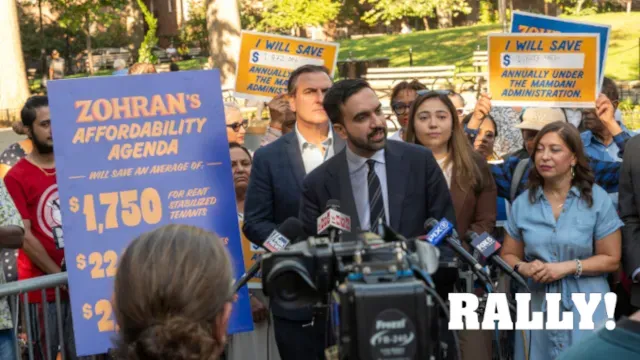
Mamdani NYC Victory: Defeating Fascism by Meeting People’s Needs
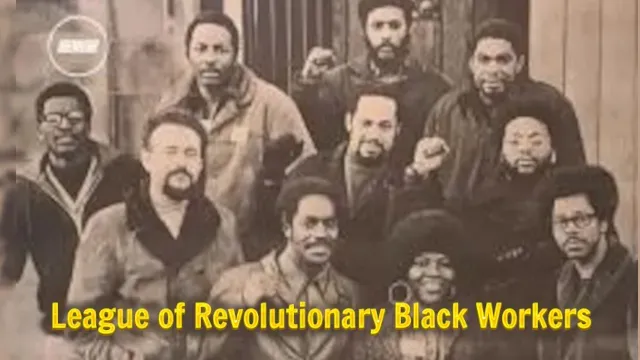
New History of Detroit LRBW Challenges Us To Think Ahead